

The fastest riders in the world don’t just train on the bike – they build strength off it too. From unilateral leg work to core stability and explosive lifts, here’s how to train like a cycling pro to generate more power, ride more efficiently and stay stronger for longer.
PICS: GETTY IMAGES
The Tour de France is one of the most brutal annual sporting event in the world, at least in the mainstream (yes, we know what The Barkley Marathons and Marathon des Sables are).
While cycling is known for its cardio benefits, it is of course, silly to assume the professional cyclists don’t do any strength training – they just train strength in a very specific way. If you’re looking to take your cycling to the next level, whether for general fitness or for performance, here’s a sense of how, and why, to train strength.
Why strength training matters for cyclists
Technique matters in cycling; efficiency is almost everything. A strong and stable body that can manage its bodyweight well is key to efficient cycling, while powerful legs will help you to transfer more energy into the wheels, generating more speed with less effort (the more power, the further you’ll go per pedal). Therefore time spent in the gym will improve your time on the saddle, or at least make it feel much easier.
How to train strength for cycling
Of course, most cyclists are incredibly lean, so getting jacked isn’t the approach – more weight and mass is simply more to contend with when climbing up a hill or riding into a strong wind.
Strength training is more about building a solid core that can hold firm for hours, shoulders that can lock for miles, and the legs to get you over the line, as well as the muscles that help these parts of the body do their thing and prevent injury.
Change your stimulus
The last thing you want to do is go to the gym and start acting like you’re cycling – you aren’t exposing your muscles to anything new, so they won’t need to adapt (become stronger).
So you want to switch out the low-weight high-repetitions for something explosive and heavier; think around six reps for three to four sets.
As cycling is a concentric exercise for the legs and isometric in the core, doing eccentric exercises will also test the muscle in new ways – a recent study also suggests that eccentric exercises are better for building muscle, tendon, and ligament strength.
Which exercises to do
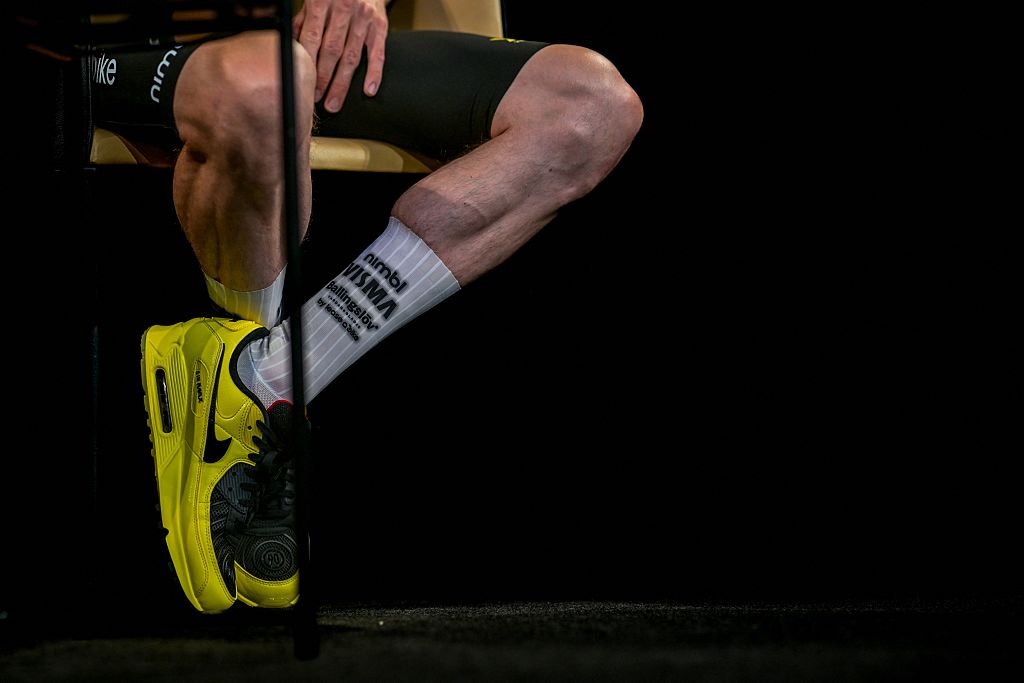
As you may expect, you want to focus mainly on legs and core, as well as a little upper body work as this will help with posture. As symmetry is important for cycling, it’s also better to train each leg individually (unilaterally) to aim to correct imbalances.
This means split squats, bulgarian split squats are often preferred by cyclists but goblet squats work well for beginners, while front and narrow split squats are also useful to incorporate as they target the quads, patellar tendon, and core also.
Single-leg deadlifts are ideal for cyclists as they target the posterior chain (your hamstrings, glutes, and lower back) while challenging core stability – ideal for improving technique. Again, you want to focus on a lower frequency of repetitions while progressively lifting heavier. A kettlebell is ideal for this exercise.
Planking is good for cycling, hate to break it to you. Front planks, with the forearms kept parallel, target the core and shoulders optimally for those gruelling rides that test the top half of you as much as the front, and you can progressively overload these either by time or by adding weight. While you’re down there, reverse plank marches are another great posterior chain exercise.
How often to strength train as a cyclist
Being on the bike is of course the best exercise there is for cycling, and the entire point. But up to two hours a week in the gym can be transformative – especially if you seem to be maxing out your ability in the saddle already.
Whether you break this into smaller 30-minute sessions, or two one-hour all-body workouts per week, is up to you, but we’d recommend the latter, as it’ll give you more days to recover properly and doesn’t have you switching from squat shoes to cleats so often.
Even the whippet-thin Pogačar does weight training, especially in the off-season, as he told Peter Attia Drive on his longevity podcast. If it’s good enough for, quite possibly, the greatest cyclist of all time, it’s alright for you.