


If your back is aching, choosing the wrong exercises could delay your recovery. Here’s what the latest research says you should be doing – and what to avoid
Back pain sends most men straight to bed rest or straight back into the gym, but, ironically, both instincts can make things worse.
The research has settled into a clearer position over the past decade: staying gently mobile beats lying still, but not every movement counts as such.
Meanwhile, some of the exercises still recommended in changing rooms and old training manuals put more load through the lumbar spine than a physiotherapist would ever prescribe. Here’s what the evidence says actually helps and what’s (probably) working against you.
Walking – good
It sounds too simple to work, but walking has the strongest evidence behind it of anything on this list. This trial, published in The Lancet, followed over 700 adults who’d recently recovered from an episode of low back pain and found that a progressive walking programme —and combined with education — roughly doubled the time before pain returned, extending it from a median of 112 days to 208.
Walking loads the spine through a natural range of motion without the compressive forces of loaded exercise and it’s the one intervention on this list that costs nothing and needs no supervision to start today.
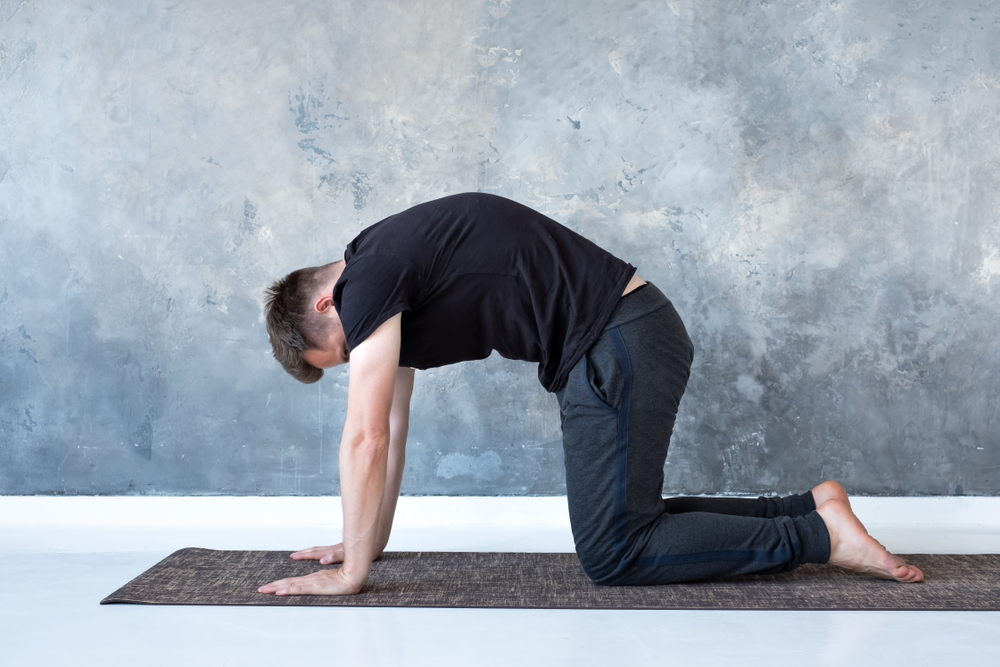
Cat-camel mobility drill – good
Moving slowly between the two ends of a spinal flexion-extension range, the cat-camel isn’t just for yoga studio. Rather, it’s.a fixture of the stabilisation programmes physiotherapists actually use in clinic.
A randomised controlled trial published in PMC built cat-camel work into the warm-up phase of a structured stabilisation protocol for chronic low back pain and reported meaningful reductions in pain and disability across the programme.
The movement itself asks little: get onto all fours, alternate between arching and rounding the spine slowly and let the discomfort guide how far you go.
Bird-dog – good
Extending opposite arm and leg from a tabletop position looks unremarkable, but it trains the deep spinal stabilisers that tend to switch off when pain sets in.
A randomised controlled trial comparing core stabilisation exercise with routine physiotherapy in chronic low back pain patients found the stabilisation group, which included bird-dog-style movements, achieved significantly greater pain reduction over the treatment period.
The exercise builds endurance in the muscles that support the spine during everyday bending and lifting, rather than raw strength, which is precisely the quality that tends to go AWOL after a back injury.
Sit-ups and crunches – bad
Sit-ups have survived in gym culture largely on reputation rather than evidence. Spine biomechanics research from the University of Waterloo’s Stuart McGill, detailed in the university’s own profile of his lab, found that a traditional sit-up imposes roughly 3,300 newtons of compressive force on the spine, precisely the threshold at which the US National Institute of Occupational Safety and Health has linked repetitive loading to higher injury rates in workers.
The repeated bending involved also engages the hip flexors, which pull directly on the lumbar spine. Instead, go for a plank or dead bug — they work the same muscles without the compression.
Standing toe touches – bad
Bending forward from standing to touch your toes concentrates almost the entire stretch at the lower spine rather than spreading it through the hamstrings, where most people assume it’s going.
Research into cumulative spinal loading has established that lumbar compression above certain thresholds is linked to disc injury over time and toe touches actually combine forward flexion with the full weight of the upper body pressing through a rounded lower back.
Opt for a supine hamstring stretch, lying on your back with a towel looped around one foot, to achieve the same flexibility gain while keeping the spine supported flat against the floor.
Heavy lifting during a flare-up – bad
Squats, deadlifts and loaded good mornings are excellent long-term tools for a resilient back and hamstrings, but not while it’s inflamed.
A study examining cumulative lifting exposure and disc protrusion found spinal loads in the region of 3,000 newtons were linked to increased risk of disc protrusion in men, a threshold that ordinary heavy lifting can reach quickly, particularly with less-than-perfect form.
During an acute flare, that load lands on tissue that’s already irritated. The sensible move, then, would be to keep moving through walking and light mobility work and step away from the barbell until the pain has settled.