

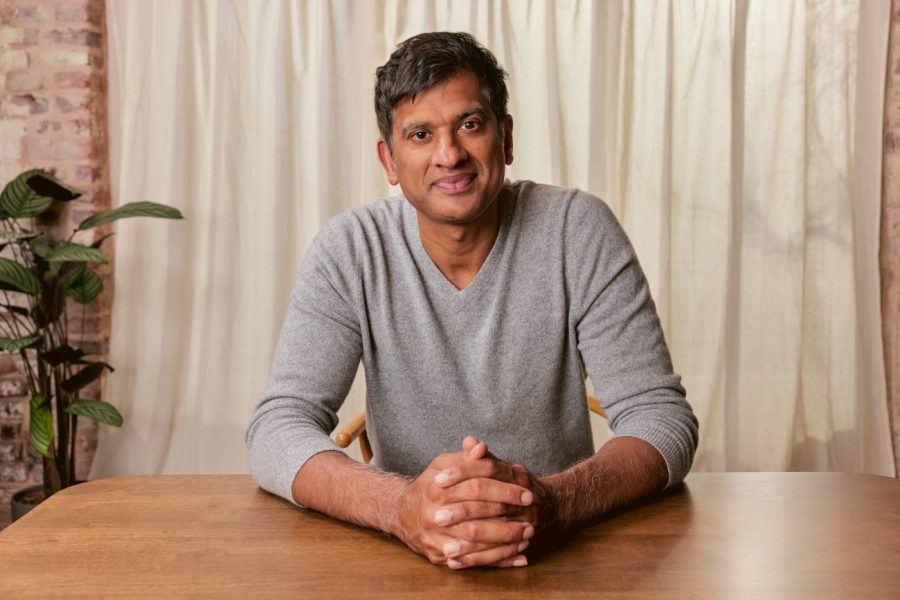
Forget the punishing workouts, extreme diets and impossible routines. Dr Rangan Chatterjee says the secret to better health lies in something far simpler: five minutes a day
PICS: VOY
Walk into Dr Rangan Chatterjee’s kitchen first thing in the morning and you’ll find a scene that feels surprisingly ordinary.
There are no ice baths waiting in the garden, no expensive recovery devices humming away in the corner and no elaborate three-hour wellness routine designed for social media.
Instead, the bestselling author, podcast host and former GP stands barefoot in his pyjamas beside a kettlebell while his coffee brews.
For five minutes, he exercises. That’s the habit he has repeated almost every day for the past seven years. Not because it’s trendy or particularly impressive, but because it works.
In an age where health advice often feels overwhelming, Chatterjee’s message is refreshingly simple. Most people don’t need to transform their entire lives to become healthier.
In fact, he believes that mindset is often the very thing holding them back. After 25 years of clinical practice and tens of thousands of patient consultations, he has become convinced that meaningful change rarely begins with grand gestures. More often, it starts with something small enough that you can’t talk yourself out of doing it.
“The belief that you have to overhaul your life is one of the biggest myths in health and wellness,” he says. “I’ve seen five-minute habits transform the lives of many of my patients, and they’re what I use myself.”
His argument flies in the face of much of the modern fitness industry. Everywhere men look, they’re told they need more. More training. More discipline. More supplements. More optimisation. The implication is that unless you’re spending hours in the gym, tracking every calorie and waking before sunrise, you’re somehow falling short.
Yet for many men, particularly those juggling careers, families and mounting responsibilities, that approach creates paralysis rather than progress. Health becomes another item on an already overflowing to-do list. The standard feels so high that many simply give up before they begin.
Chatterjee understands those pressures. At 48, he’s navigating many of the same challenges faced by the readers he’s trying to reach. He’s married, has two children, runs a busy business and cares for his elderly mother, who lives nearby. He knows what it feels like to be stretched for time.
That’s precisely why the five-minute philosophy resonates so strongly with him.
Why Big Transformations Usually Fail
The self-improvement world has built an entire industry around dramatic transformation. Every January, millions of people commit to becoming a new version of themselves. Gym memberships surge, nutrition plans are downloaded and ambitious promises are made.
By February, most have disappeared.
Chatterjee isn’t surprised. While he has occasionally seen people make overnight changes, those moments almost always follow a major life event. A heart attack. A divorce. A bereavement. Something significant enough to fundamentally alter how a person sees their future.
“For most people, big transformations don’t last,” he says.
The reason is rooted in human psychology. We tend to assume motivation is a permanent resource when, in reality, it fluctuates constantly. Researchers refer to this as the motivation wave. Some days enthusiasm is high and everything feels possible. On other days, stress, fatigue and life’s inevitable complications make even simple tasks feel difficult.
The mistake many people make is creating a health plan that only works when motivation is high.
“If you’re saying you have to work out for 45 minutes every day, then when you’re tired, stressed and busy, you’re not going to do it,” says Chatterjee. “It feels too hard.”
Five minutes changes the equation. It’s short enough to fit into almost any day, yet substantial enough to create a sense of achievement. More importantly, it’s achievable even when motivation disappears.
That consistency is where the real benefits begin.

Building Trust In Yourself
When Chatterjee talks about his five-minute kitchen workout, he isn’t really talking about exercise. At least not exclusively.
The physical benefits are obvious enough. As men age, muscle mass naturally declines. From around the age of 30, we begin losing lean muscle tissue unless we actively work to maintain it. Preserving strength isn’t simply about aesthetics; it’s one of the strongest predictors of healthy ageing.
But Chatterjee believes the psychological benefits may be even more powerful.
Every morning, before emails, meetings and family demands begin competing for his attention, he does something important. He keeps a promise to himself.
“No matter how busy I am, no matter what my wife needs from me, what my children need from me or what my colleagues need from me, I’ve still found five minutes to look after myself,” he says.
That simple act reinforces a powerful message: your wellbeing matters.
Over time, those daily deposits accumulate into something many men are missing: self-trust. The confidence that comes from knowing you’ll follow through on your commitments. Not because you’re highly motivated, but because you’ve made the behaviour automatic.
Chatterjee often compares the habit to brushing your teeth. Most people spend around four minutes each day looking after their dental health and rarely question whether it’s worthwhile. They understand that those few minutes, repeated consistently over decades, have enormous value.
Yet when it comes to physical and mental wellbeing, many assume that anything less than an hour is pointless.
“We somehow make health much more complicated than it needs to be,” he says.
The Three Rules Of Lasting Change
Much of Chatterjee’s approach is influenced by his studies with behavioural scientist Professor BJ Fogg, one of the world’s leading experts on habit formation.
The first rule is simple: make the habit easy.
Most people fail because they start too big. They try to become the sort of person who trains six times a week when they’re currently doing nothing. They commit to meal prepping every lunch, meditating for half an hour and running before work. The ambition is admirable, but the behaviour is unsustainable.
Five minutes removes that barrier.
The second rule is to attach a new behaviour to an existing habit. Chatterjee’s workout doesn’t require extra planning because it sits naturally within a routine that already exists. Every morning, he makes coffee. While the coffee brews, he exercises. The new habit piggybacks the old one.
The third rule is to shape your environment, so success becomes the easiest option. A kettlebell and dumbbell sit permanently in his kitchen. They’re impossible to ignore.
“If I put them in the garage, I won’t use them,” he admits.
The equipment acts as a visual reminder, but it has also influenced the rest of the household. His children have grown up watching him exercise. Unsurprisingly, they’ve started picking up the weights themselves.
“As a father, I want to model healthy behaviours,” he says. “I want my children to see that looking after yourself is normal.”
Body, Mind And Heart
Although exercise is often the headline-grabber, Chatterjee’s five-minute philosophy extends much further. He encourages people to think about health through three interconnected lenses: body, mind and heart.
The body is perhaps the easiest to understand. Five minutes of movement, whether that’s strength training, star jumps, a brisk walk or stretching, is enough to begin building momentum.
The mind requires a different approach. One practice Chatterjee has used for years is a simple journalling exercise built around three questions.
What is one thing I deeply appreciate about my life? What is the most important thing I need to do today? Which quality do I want to showcase to the world today?
The exercise takes less than five minutes but serves multiple purposes. Gratitude helps counter the brain’s natural negativity bias. Identifying a single priority creates clarity in a world of competing demands. Choosing a personal quality such as patience, compassion or courage encourages intentional behaviour rather than automatic reactions.
The final pillar is heart, which has nothing to do with cardiovascular fitness and everything to do with human connection.
Modern men are increasingly disconnected. Despite living in a hyperconnected world, loneliness continues to rise, particularly among men aged between 30 and 50. Chatterjee sees it as one of the defining health challenges of our time.
Research has linked chronic loneliness to increased disease risk and poorer mental health outcomes. Some studies have even suggested that prolonged social isolation can be as damaging as smoking.
His solution is remarkably straightforward: create regular opportunities for connection.
For Chatterjee, that often means a nightly tea ritual with his wife. Once their children are asleep, they sit down together for at least five minutes before doing anything else.
Sometimes the conversation lasts longer. Sometimes it doesn’t. The important thing is showing up.
The Missing Ingredient: Discomfort
Another recurring theme in Chatterjee’s work is the importance of doing difficult things.
Modern life has become extraordinarily convenient. Food can be delivered to your door. Entertainment is available instantly. Conversations can be avoided through messaging apps. Physical effort is increasingly optional.
While convenience has obvious benefits, Chatterjee believes many people have become disconnected from an important source of confidence: overcoming challenges.
“I’ve noticed that many people have a kind of low-grade anxiety because they never do anything hard,” he says.
Discomfort doesn’t have to be dramatic. It can be taking the stairs instead of the lift. Making the difficult phone call you’ve been avoiding. Speaking honestly when it’s easier to stay silent.
Every time you choose the harder option, you reinforce a powerful belief about yourself. You remind yourself that you’re capable. And capable people tend to make better decisions.
The Power Of Starting Small
Perhaps the most important aspect of Chatterjee’s philosophy is that it isn’t anti-ambition. He isn’t suggesting that five minutes of exercise is the ultimate goal. Nor is he arguing that nobody should spend longer training, meditating or pursuing health.
The five-minute habit is simply the starting point.
What makes it powerful is that it creates momentum. Someone who consistently exercises for five minutes each morning is more likely to walk at lunchtime. They’re more likely to make healthier food choices. They’re more likely to sign up for a Parkrun or join a local sports club.
The initial action triggers a cascade of positive behaviours.
That’s why Chatterjee remains so passionate about the concept. After decades of practising medicine, he’s seen enough evidence to know that lasting change rarely arrives through dramatic transformation. More often, it begins with something deceptively modest.
Five minutes. Not because five minutes will solve every problem.
But because five minutes done consistently can become the foundation upon which an entirely different life is built.
Can Five Minutes Really Change Your Future Health?
For Dr Rangan Chatterjee, the philosophy behind five-minute habits isn’t simply about feeling better today. It’s also about preventing the health problems that many men assume are inevitable later in life.
One of the ideas that shaped his latest venture, Do Health, is the belief that most chronic diseases don’t appear overnight. Conditions such as type 2 diabetes, heart disease and even dementia often begin developing years, sometimes decades, before symptoms become obvious.
“Heart attacks don’t suddenly start when you’re 50,” says Chatterjee. “The processes that lead to them may have been building in the body for 10, 15 or 20 years.”
The challenge, he argues, is that traditional healthcare systems are primarily designed to diagnose and manage disease once it has appeared. Prevention often receives far less attention.
That’s where Do Health aims to bridge the gap.
The platform combines blood testing, personalised coaching and ongoing monitoring to help users understand what’s happening inside their bodies before serious problems develop. Rather than focusing on hundreds of biomarkers that can leave people confused and overwhelmed, the service measures a carefully selected group of key markers linked to metabolic health, inflammation and long-term disease risk.
The idea is simple: if you know what’s happening beneath the surface, you’re more likely to take action. Chatterjee points to a well-known management principle: what gets measured gets managed.
“If someone can see they’re moving towards type 2 diabetes or cardiovascular disease, they don’t need to wait until they’re diagnosed before making changes,” he says.
What makes the approach different is the emphasis on behaviour change rather than simply delivering results. Users receive personalised recommendations based on their individual data and circumstances, helping them identify realistic steps they can take to improve their health.
In many ways, the philosophy mirrors the one that underpins Chatterjee’s five-minute approach. The goal isn’t perfection. It’s progress.
Small actions repeated consistently can create meaningful change over time, whether that’s improving fitness, reducing stress or moving important health markers in the right direction.
For men who like evidence as much as motivation, Do Health provides something tangible: proof that the daily habits they’re building are having a measurable impact.
And for Chatterjee, that’s ultimately what prevention is all about—not waiting for illness to arrive, but taking simple, sustainable steps to stay healthier for longer.