
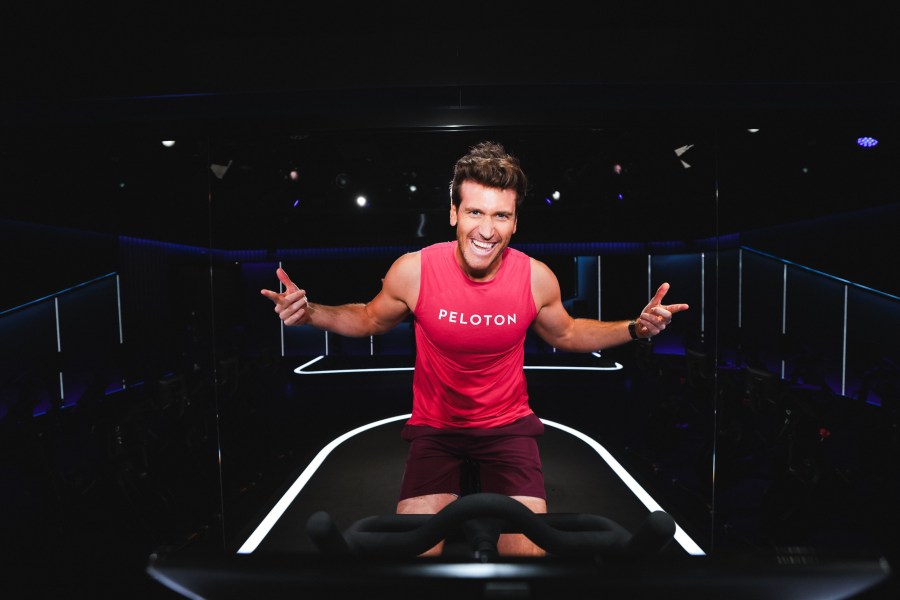
From a life-threatening stroke at 34 to becoming one of Peloton’s most recognisable instructors, Bradley Rose opens up about resilience, reinvention and why setbacks can become your greatest advantage
There’s a moment in every high-performance life where momentum feels unstoppable – when everything you’ve worked for is finally within reach.
For Bradley Rose, that moment came in New York City.
He was building a career across multiple fronts: teaching at Rumble, one of the world’s most talked-about boutique fitness brands, while simultaneously carving out a path in acting. Roles were coming in. Opportunities were stacking up. The trajectory was clear.
And then, in an instant, everything stopped.
“I walked into the studio to teach a class – there were about 80 people in the room – and suddenly the lights just went out,” Rose recalls. “I remember being on the floor thinking, ‘That’s weird…what’s going on?’ Then came the worst headache.”
He had suffered a stroke. At 34.
When your body betrays you
For most people, stroke is something distant – an issue associated with ageing, not peak physical condition. For someone immersed in fitness, it feels almost inconceivable.
“You just don’t think it can happen to you,” says Rose. “You hear about cancer, you hear about injuries – but stroke? That’s something you think happens to your grandparents.”
The reality was far more brutal. Physically, his left side weakened. Mentally, everything fractured. Memory, language, recognition – basic cognitive functions became unreliable.
“I couldn’t remember things. You’d show me something simple, and I’d get it wrong. My brain was there, but everything felt scrambled.”
For someone whose identity was built on performance – physical, mental, and emotional – the experience was destabilising in the extreme.
“You think your career is over,” he says simply.
The long way back
Recovery wasn’t linear – and it wasn’t immediate.
While his physical strength began to return relatively quickly, the cognitive side lagged behind. And perhaps more challenging than either was the psychological impact: the loss of confidence.
Rose initially tried to push straight back into work – auditions, teaching, performing – but it quickly became clear he wasn’t ready.
“I was going into auditions and forgetting my lines. I remember saying to my wife, ‘I can’t do this. Something’s not right.’”
Then came an unexpected turning point: lockdown.
As the world shut down during the pandemic, Rose found himself with something he hadn’t allowed before – time.
“I gave myself six months to just stop,” he says. “And honestly, it was the biggest blessing. I needed that space to recover properly.”
It’s a reminder that recovery – whether from injury, illness, or burnout – rarely happens on a schedule. Sometimes, the most productive thing you can do is pause.
A second chance – and a new platform
Before his stroke, Rose had already been approached by Peloton. At the time, he turned it down.
Then came a message from fellow instructor Cody Rigsby. “He just reached out and said, ‘We’re looking for instructors again—do you want to try?’ He didn’t even know what I’d been through.”
This time, Rose said yes. Despite lingering doubts – reduced muscle mass, shaken confidence, ongoing recovery – he leaned into what he did know: he loved performing.
“I love being in front of a camera. I love connecting with people. That’s the best part of the job.” That instinct proved decisive.
Within a platform built as much on personality as performance, Rose found his footing – and then his voice.
The power of connection
Peloton’s success isn’t just built on equipment or programming – it’s built on people. Instructors aren’t just trainers; they’re personalities, motivators, and, increasingly, community leaders.
For Rose, the key to that connection is surprisingly simple. “You can only ever teach to one person – and that person is the camera,” he explains.
“I can’t make the class about the people in the room, because there might be thousands watching online. So, I imagine I’m talking to one person – my mum, my wife, a friend – and I build everything around that.”
It’s a philosophy rooted in authenticity. Speak to one person honestly, and you’ll reach thousands.
Keeping it fresh
Of course, there’s a challenge inherent in repetition. At its core, every class follows a similar structure. The bike doesn’t change. The format doesn’t change.
So how do you avoid becoming predictable? Rose’s answer: curiosity – and a willingness to embrace the absurd.
“I treat it like I’m training with my best mate,” he says. “We’d be chatting, joking, talking about random stuff – so I bring that into the class.”
That might mean referencing current events, pop culture, or something completely leftfield.
“I read a story about NASA measuring an asteroid in ‘14 flamingos’. I thought, ‘That’s ridiculous – that’s going in the class.’”
It’s this blend of humour, relatability, and spontaneity that keeps his sessions engaging – and distinctly his own.
More than physical strength
If the stroke forced Rose to rebuild his physical capabilities, it also reshaped his mindset.
Subsequent challenges – including a cancer scare and a difficult fertility journey – only reinforced that shift.
“When I found a lump and they said it could be a sarcoma, of course it was scary,” he says. “But my mindset was completely different.”
Instead of spiralling, he focused on control, support, and perspective. “After the stroke, I’d already been to that dark place. What I built after that made me stronger.”
That strength isn’t just physical – it’s psychological resilience, the ability to absorb setbacks without losing direction.
The unseen battles
Behind the polished image of a fitness professional lies a reality that many will recognise: health struggles don’t discriminate.
Rose speaks candidly about fertility challenges, including discovering a motility issue that required surgery.
“It took us about three years before we realised something wasn’t right,” he says. “Then everything becomes clinical – tests, procedures, timelines.”
The emotional toll can be as demanding as the physical. “You go from something that’s meant to be natural and enjoyable to something that’s scheduled and stressful.”
The eventual success – conceiving after treatment – was, he says, “incredible.” But the journey left its mark.
Performance, personality – and perspective
Today, Bradley Rose is juggling multiple strands: Peloton instructor, actor, podcast host. Opportunities are expanding – roles, collaborations, new projects.
And he’s clear about where that momentum comes from. “My profile has grown because of Peloton,” he says. “I’m not naive about that. It’s an incredible platform.”
But it’s what he’s done with that platform – his openness, his energy, his relatability – that has made him stand out.
In an industry often obsessed with perfection, Rose offers something more valuable: honesty.
Looking ahead
So, what’s next? In the short term, it’s about growth – within Peloton, within acting, within his personal brand. In the longer term, it’s about sustainability.
“I want to keep doing good work,” he says. “Keep building, keep improving, and stay here as long as I can.”
It’s a grounded ambition, one shaped by experience. Because when you’ve had everything taken away once, success isn’t just about progression. It’s about perspective.
Rose’s story isn’t just about recovery – it’s about reinvention. It’s about understanding that setbacks don’t erase potential; they redefine it.
And perhaps most importantly, it’s a reminder that strength isn’t just measured in watts, reps, or performance metrics. Sometimes, it’s simply measured in your ability to start again.