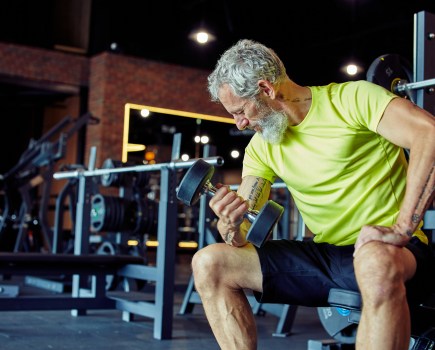


Mobility, recovery and smart training become increasingly important with age. One experienced lifter shares the simple habits that keep him training pain-free
WORDS: James Dixon PICS: Getty Images
The morning after a heavy deadlift session, I generally find that my lower back has all the flexibility of reinforced concrete – I call it my deadlift hangover. It’s not pain – far from it. But it’s a reminder that I’m no longer twenty-one.
At 36, I’m still lifting heavier than most people tend to, but I’ve reached the point at which longevity matters every bit as much as another personal best, and that no personal best is coming if I don’t keep an eye on longevity.
As a former professional personal trainer, I still love chasing strength, fatigue, and adaptation. There’s nothing quite like adding another plate to the bar or grinding a session out until you’re almost flat on your back.
However, you learn as you age that the strongest lifters are the ones who do the background work and stay consistent, not the flashy, all-out ones. They’re also the ones who are still training pretty consistently, ten or twenty years later.
Heavy lifting isn’t the problem. In fact, a growing body of research shows us that resistance training is one of the best things we can do as we age.
Performed properly, it will strengthen your muscles, of course; it will also improve bone density, help to maintain the soft tissue supporting our joints, and keep our endocrine systems sound, among other benefits.
Think bigger picture
What catches people out usually isn’t the lifting itself – it’s everything surrounding it. If you have poor recovery protocols in place, overlooking mobility work, poor diet, ego lifting, ignoring the warning signs of accumulating stiffness and inflammation, and so on, then it will catch up with you, especially as you age.
I spent a fair amount of time and thought on joint health. I spend around five minutes moving every morning as the coffee brews. If I’ve deadlifted or squatted the day before, and my back is feeling stiff, I’ll work gently through spinal rotations, hip openers, shoulder mobility, and hamstring stretches. Five minutes isn’t really long enough to transform for flexibility, but it at least gets the blood and synovial fluid flowing, and it’s enough to remind my body that it’s designed to move.
Consistency beats intensity here (like most things in fitness).
Yoga also helps. I’ve practised it for years, but it’s really come into its own over the last couple of years. I used to think of it as something entirely separate to strength training; nowadays it’s crucial to my gym work.
I usually roll the mat out most days that I’m not lifting, and even some days when I am. Just half an hour a few times a week can make a massive difference – it helps with hip and shoulder mobility, helps undo some of the stiffness that inevitably follows heavy compound lifts and, perhaps most importantly, encourages proper recovery. Slowing things down for a bit also gives me a nice juxtaposition to the hard work I do in the gym.
Getting enough shuteye
Sleep is a tricky one. I’m an active, working dad with a young family. I often don’t manage a full eight hours. However, getting in a full 7-9 hours of sleep when you can is massive – your muscles repair, connective tissues recover, and hormones involved in recovery all benefit from good-quality rest. This only becomes more important as you age.
Supplementation is important, and I keep mine refreshingly uncomplicated (I think). I take an omega-3 supplement every day (sea kelp, as I’m a vegetarian – it’s just as good as cod liver oil) on top of my creatine and whey. I can feel the difference if I ever go a few days without taking it, whether I’m travelling or happen to have run out. My joints ache, my right elbow and left ankle grind, and I can’t lift comfortably as a result.
I used to neglect supportive equipment a bit. I’d use old fashioned straps for deadlifts and heavy rows, a lifting belt, and not much else. That all changed when I hit 35 and my elbows and wrists began grinding! I use Versa Gripps* for many of my heavier pulling exercises nowadays – rows and deadlifts become much more productive when grip isn’t the limiting factor, as we know, and it stops my finger and wrist joints from having to take on too much load.
Similarly, I use wrist straps for pressing movements, and even for barbell squats and barbell/EZ curls. The support honestly gives me a few extra reps, a few extra sets, or perhaps an extra little plate on each side. And it keeps me safe! I’ve also always got elbow straps on, too, no matter what I’m training. They keep the joints warm and well-supported so that any strain is going into my muscles, where it belongs, and so they can take anything I throw at them.

Perhaps the biggest change is a bit of a mindset shift. I still push myself hard and am currently near the strongest I’ve ever been. However, my relationship with training has matured as I’ve moved through my thirties. I’m no longer trying to prove how indestructible I am (most of the time). I’m just trying to become durable, so that I’m still in good shape in thirty years’ time.
If a few minutes of mobility every morning, yoga on my rest days, sensible recovery, a handful of supplements and a few well-chosen pieces of kit help me stay under the bar until them, I’ll sit up and happily pay attention.
*I’m not sponsored by them at all, it’s just a solid piece of kit.
• James Dixon is a freelance journalist and former personal trainer with nearly twenty years’ experience in the fitness industry. He has written on health, fitness, parenting, culture and social affairs for publications including The iPaper, Spiked, The National, FitnessBrain, FitnessPush, The Westender, and The Green Parent, combining practical expertise with evidence-based reporting and accessible, engaging writing.