

New Guinness World Record holder Sam King on fatigue, focus and ultra-endurance running 80 ultras in 80 days
Running one ultramarathon is an achievement. Running one every day for almost three months borders on the unthinkable. Sam King set out to complete 74 ultramarathons in 74 days – one for every year of his mum’s life before she suffered a life-altering brain bleed – in support of brain injury charity Headway UK. He didn’t stop there, finishing an astonishing 80 in 80.
Across nearly 2,500 miles, Sam combined ruthless discipline with deep personal purpose, raising well over his £74,000 target in the process. Men’s Fitness managed to stop him running long enough to discover more about surviving relentless fatigue, managing recovery with no margin for error, and the mindset that carried him to the finish.
Men’s Fitness: Sam, 74 ultramarathons in 74 days is extreme – completing 80 in 80 is on another level. How did you prepare your body for the cumulative fatigue of running 50km every single day?
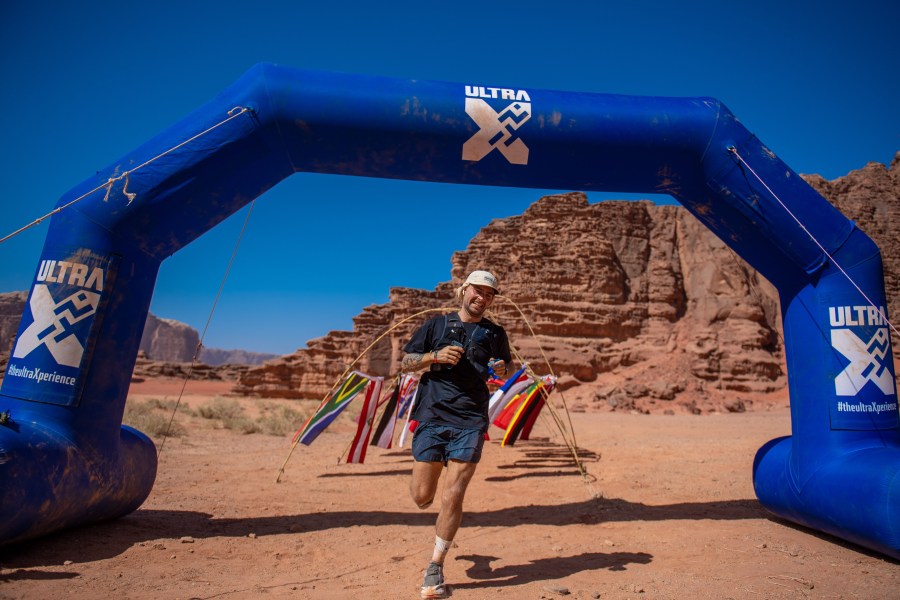
Sam King: The fact I could even attempt this came down to seven or eight years of building physical and mental resilience beforehand. I started running in 2018 and fell in love with multi-day ultras in 2022, when I raced a five-day, 250km desert ultra in Jordan. Before this challenge I’d completed around 70-80 marathons and ultramarathons, so I had a strong base and a good injury history. More importantly, I’d conditioned my body – and my mind – to tolerate repeated stress over long periods.
MF: What surprised you most about how your body adapted with virtually no recovery window?
SK: I’d already seen adaptation during multi-day races in harsh environments, where I’d often feel strongest towards the end. Sometimes I’d finish a five-day race wanting a day six. What surprised me here was how long the adaptation took – around two to three weeks – but once it kicked in, it wasn’t physically overwhelming. I was obsessive about the basics: sleep, nutrition, mobility. Mindset was huge too. I genuinely believe you can guide your body into extraordinary things if your head is in the right place.
MF: Talk us through a typical day – from waking up to refuelling, mobility and sleep.
SK: I’d wake about two hours before the run – usually 6am for an 8am start – and that’s when the calorie clock started. Appetite was a constant battle, so breakfast was usually a packed smoothie with banana, peanut butter and dates. I ate little and often because big meals wiped me out.
I ran three 10-11 mile loops starting and finishing at the house, so I could refuel without carrying much. I’d aim for at least 60g of carbs per hour. I usually finished by 1-1.30pm, got straight into recovery shakes, showered, stretched, foam rolled, then lay flat for an hour. Main meal around 4-5pm, then wind down and aim for 8-9 hours’ sleep. It was full-on – running, eating, filming content, visiting my mum – but it worked.
MF: With recovery limited, what strategies were non-negotiable?
SK: Pace was everything. My coach and I settled on around 6:00 min/km – fast enough to finish in five hours, conservative enough to stay healthy. Finishing early gave me 18–19 hours to recover. During that time, eating enough, sleeping well and staying off my feet were non-negotiable. I didn’t overcomplicate it – fuel, rest, sleep.
MF: You weren’t always an endurance athlete. How did you go from gaming addiction and weighing 19 stone to daily ultras?
SK: I was number one in the world on Call of Duty and weighed 19 stone – so I knew I had an extreme mindset, it was just pointed in the wrong direction. In 2018 I got a last-minute London Marathon place, set a 3:30 goal and ran 3:29. Crossing that finish line changed everything. A month later I ran 100km, and from there it just escalated.
MF: When motivation dips and the legs are shot, how do you keep moving?
SK: “If the why is powerful, the how is easy” – that was everything. Running one ultramarathon for every year of my mum’s life gave me total emotional buy-in. Add in the support online and the donations coming in, and quitting was never really an option.
Practically, music played a huge role. I had dedicated Spotify playlists, saved podcasts, and made the runs open-invite so people could join me. Conversation passes time fast. The hardest moments were bad weather on the Frinton seafront – but I even had a playlist for that, and once you’re out there, extreme weather becomes part of the experience.
MF: Injury risk must have been constantly on your mind. How did you manage niggles and warning signs?
SK: Injury or illness was the biggest threat, so I controlled every variable I could. Flat routes, mostly tarmac, minimal trails. I rotated between two pairs of shoes and never went beyond 500km per pair.
I had a scare around day five – a tendon in my right foot swelled badly and I had to move from a size 9.5 to an 11. That nearly ended it. I avoided painkillers and anti-inflammatories because I wanted real feedback from my body. Aside from that, some knee discomfort and two days of being properly ill, I stayed largely injury-free.

MF: How did your fuelling evolve – and what mistakes did you make?
SK: Early on, fuelling was very disciplined and my weight didn’t change for the first month. But eating around 5,500 calories a day for 80 days wears you down. Eventually it became about eating whatever I could tolerate.
Pizza became a staple, and M&S scotch pancakes were a constant. This wasn’t a high-performance race – it was about survival. I lost around 9kg overall, but I judged nutrition by how I felt day to day. You learn to listen to your body quickly. Going forward, as I return to racing and faster marathons, nutrition will be far more structured again. Thanks in main to my friend and nutritionist Abi, who works with GB Olympic teams and is an absolute genius.
MF: What lessons from Project 74 apply to the average Men’s Fitness reader?
SK: To get good at anything, you have to love it – but you rarely love fitness straight away. Pick something you think you might enjoy and commit to the process. Set a goal – Couch to 5K, a marathon, anything – train properly, achieve it, then decide if it’s for you.
If it is, enjoy the journey. If not, try something else. Just be patient. Good things come to those who wait.
• To support Sam head to https://givestar.io/gs/project-74 – or follow hom on @fatboysking