
On World Mental Health Day, we take a look at the rise and rise of Men’s Circles that is helping men open up about issues with the power of brotherhood
When Pasco Ashton first sat down in a men’s circle, he didn’t know what to expect. What he found, though, was something quietly powerful – a space where men could talk honestly, listen deeply, and begin to understand themselves and each other in ways they rarely did elsewhere.
“It all started very organically,” says Ashton, who founded Men’s Circles in 2019. “I’d been on my own journey – doing retreats, looking inward, trying to make sense of who I was as a man. I realised I wasn’t the only one asking those questions.”
That curiosity became a calling. What began as a handful of men meeting weekly online has grown into a nationwide network – from Cornwall to Scotland – where men gather to speak freely, without judgement or expectation. The format is simple but structured: a check-in, a grounding exercise, a round of sharing, and clear agreements that create safety and trust.
“We start every session by reminding each other that all emotions are welcome,” Ashton explains. “It’s about creating a space where men don’t have to fix anything or pretend everything’s fine. They just have to show up and be real.”
Breaking the stigma of “Man Up”
The idea might sound simple, but it pushes back against centuries of conditioning. From boyhood, many men are told that vulnerability equals weakness. Phrases like “man up” and “boys don’t cry” teach men to suppress emotion, creating a culture where admitting struggle feels shameful.
Research shows this stigma is one of the biggest barriers to men seeking help for mental health issues. “Society has built this idea that being a man means being self-reliant and stoic,” Ashton says. “But that’s not strength – that’s isolation. And isolation is killing men.”
Indeed, men remain far less likely than women to seek support, even as they face higher rates of suicide and substance abuse. The issue isn’t a lack of need; it’s a lack of safe, relatable spaces. That’s where the circles come in.
“It made me realise I wasn’t alone”
One man who’s felt the impact firsthand is Peter Phillip, now a trained facilitator within the Men’s Circles movement. His journey began at a Radical Honesty retreat – an intense weekend of truth-telling that left him questioning how disconnected many men, including himself, had become.
“There were about twenty of us, and it really struck me how many of the women there had had bad experiences with men,” he says. “It made me think about what kind of man I wanted to be – and the kind of relationships I wanted to have. I realised I’d spent years thinking I didn’t need people, when actually I was missing something huge.”
Back home, Phillip typed “men’s circle” into Google and joined a group. Within six months, he was facilitating his own. “I wanted to help create spaces where men could do the kind of inner work that makes them better friends, partners, and fathers,” he says. “It’s not therapy. It’s connection.”
How the circles work
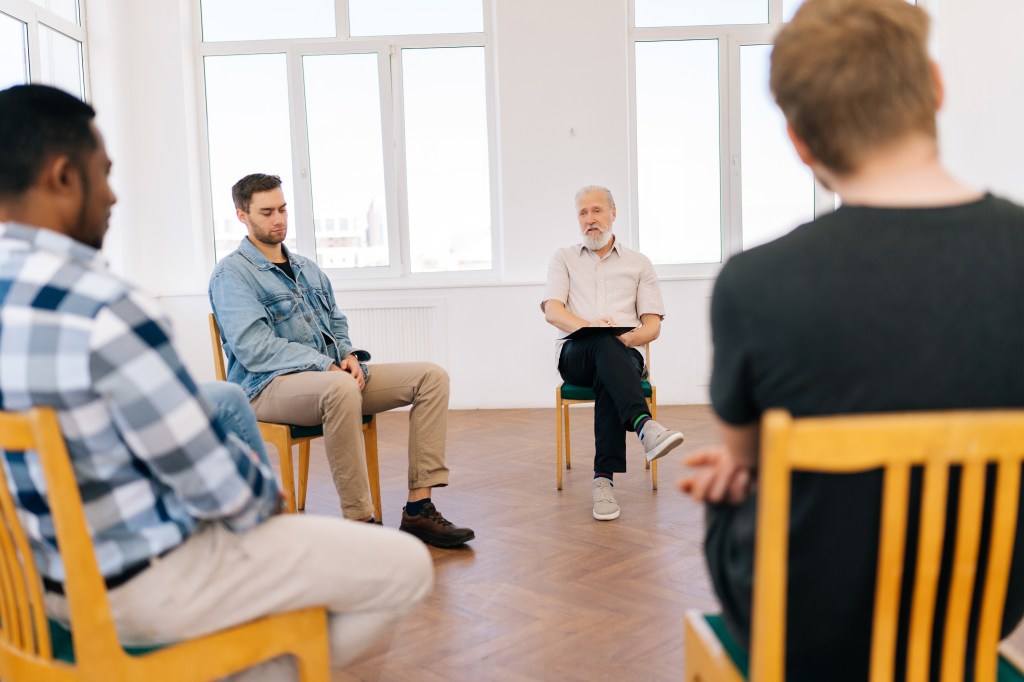
Each session begins with what facilitators call “the agreements” – a set of principles that establish trust: confidentiality, respect, and a reminder that all emotions are valid. Then comes a simple “check-in”, where each man rates how he feels from 0 to 10 and adds three words to describe his state.
“It’s a gentle way to start reflecting,” says Phillip. “Just saying those words out loud can be a big step.”
A short grounding exercise follows – a moment to breathe, settle the nervous system, and shift from the rush of daily life. Then comes a warm-up question like “What’s challenging you right now?” before one or two men take longer turns to speak more deeply, while others listen.
“The structure gives permission for honesty,” Phillip explains. “You start with baby steps – and before long, you’re sharing things you’ve never said out loud.”
Why traditional therapy doesn’t always fit
While therapy remains vital, many men find traditional models hard to engage with. As studies show, conventional mental health services often rely heavily on verbal emotional expression – a format that doesn’t always resonate with men shaped by cultural expectations of toughness or self-reliance.
“Some men just can’t relate to sitting in a clinical room and talking about feelings,” Ashton says. “But give them a space where they can speak to other men, with no agenda and no judgement – that’s where they open up.”
Experts suggest therapy for men might benefit from being more action-oriented – incorporating problem-solving, goal-setting, or even physical activities such as outdoor workshops or team sports. “We’ve had guys join our circles who’d never have gone near a therapist’s office,” says Phillip. “Now they’re having open, emotional conversations every week. That’s huge.”
In many ways, Men’s Circles are helping men rediscover something they’ve lost: community. “We used to have more spaces like this,” Phillip reflects. “In the pub, at work, in local clubs – places where men talked, shared, and looked out for each other. Modern life’s fragmented that. The circles are about rebuilding those connections.”
That sense of belonging often translates into visible transformation. “I’ve seen men arrive completely shut down,” says Ashton. “Six months later, they’re more confident, more present, more connected – not just to others, but to themselves.”
Changing the narrative
More and more facilitators are, like Peter Phillip, being trained to run local, in-person and ‘Zoom-based’ circles, bringing the model into communities across the UK. “The goal is to make this as normal as going to the gym,” says Ashton. “You train your body, you train your mind – why not your emotional awareness?”
For both Ashton and Phillip, the mission is simple: change what it means to be a man. “Men are often told that courage is about being hard,” Ashton says. “We’re showing that real courage is being honest.”
Phillip agrees. “It’s okay to talk about what’s going on for you. In fact, it’s vital. Once you realise you’re not the only one, everything shifts. You stop pretending – and start living.”