
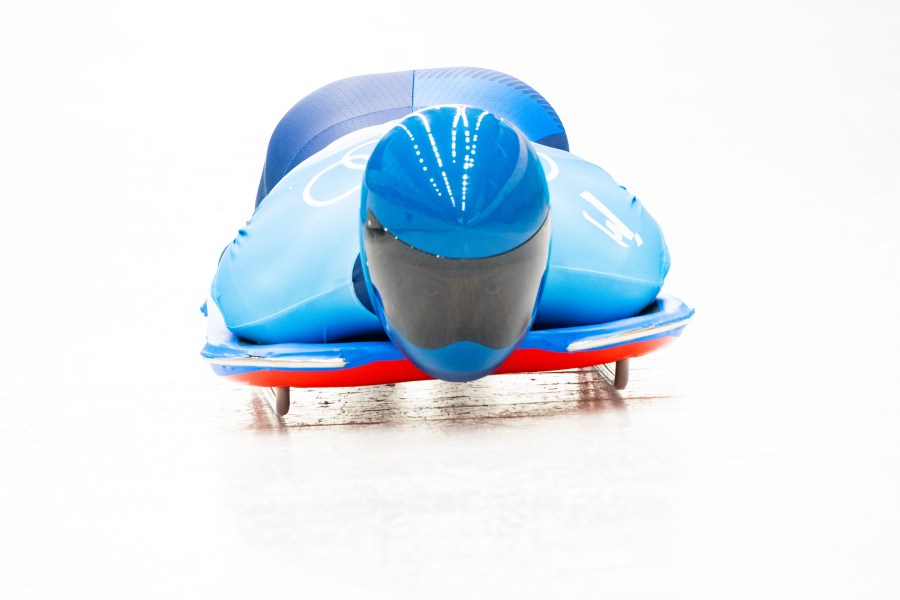
Skeleton racer Matt Weston scooped Britain’s first medal of the 2026 Winter Olympics. He tells Men’s Fitness about his preparation and training for Milan Cortina
Matt Weston has secured his first Olympic title, taking home the gold in his final run in the men’s skeleton at the 2026 Winter Olympic in Milan Cortina.
After turning in back-to-back track records, 56.21sec, and 55.88sec, in the qualifying rounds of the skeleton, he fulfilled his Olympic dream in the final run winning by almost a second. We caught up with the two-time skeleton world champion to find out about power, speed and surviving the fastest minute in sport.
Men’s Fitness: You’re speaking to us from Lake Placid — what brings you there at this time of year?
Matt Weston: There’s no ice track in the UK, so while we can train the start on a push track at home, we have to travel abroad to actually slide. Here we’ve got an on-ice start facility, which feels completely different to rails. It’s basically a physical camp focused on pushing the sled, then later in the autumn I’ll head to Norway to start full sliding sessions.
“Skeleton is basically a hybrid between a sprinter and a weightlifter”
MF: Your Instagram shows a lot of gym work. What does strength training look like for a skeleton athlete?
MW: People are always surprised — I don’t really do dedicated upper-body sessions. I haven’t in about nine years. Any upper-body work comes from compound lifts like cleans, snatches, squats and deadlifts.
If I build a big upper body it actually makes me slower because it’s less aerodynamic. The sport is all about power-to-weight ratio. We train like a mix between a sprinter and a weightlifter: strong enough to launch a 40kg sled, then fast enough to sprint downhill while pushing it.
MF: So the start is everything?
MW: Completely. If I’m one-tenth faster at the push, I’ll be three to four-tenths faster at the bottom. We don’t have engines — acceleration is our engine. That’s why our summers are all about explosive work: sprinting, jumping, plyometrics.
The plyometric drills that build Olympic speed
MF: What exercises could readers steal for their own training?
MW: We build it progressively. Early summer is low-level contacts — pogo jumps, lots of reps just teaching the body to react fast. Then it progresses into tuck jumps, counter-movement jumps and reactive jumps.
We do them on force plates, which measure watts per kilo and reaction speed. You can’t cheat — it shows how much force you produce rather than how high you tuck your knees. It becomes competitive too. My teammates and I are always trying to beat each other. That’s a massive motivator when you’re repeating the same explosive work every day.
MF: What does a normal week look like?
MW: Wednesdays and Sundays are rest days — although even then we’re doing mobility or Pilates.
Monday: sprint or push session in the morning, heavy strength in the afternoon
Tuesday: gym and conditioning work
Wednesday: recovery work
Thursday: repeat Monday
Friday: lighter day
Saturday: major sprint session
It’s not huge hours — it’s intensity. Every rep is maximal effort. I’m about 83kg but I’ll Bulgarian split squat around 180kg. That surprises people… especially in a public gym. Ironically, I’ve never benched 100kg — which annoys me more than it should.
MF: Has your approach changed over your career?
MW: Definitely. Early on I trained insanely hard — probably too hard — and picked up injuries. Now I focus on efficiency. Same intent, but smarter decisions: fewer reps if my knees are sore, or an extra rest day if needed.
There isn’t one perfect programme. My teammates might handle more volume than me and we’ll still reach the same level. Understanding your body is huge at elite level.
MF: What fuels a skeleton athlete?
MW: I’m pretty food-first. I adjust intake based on hunger and training load and stay around the same bodyweight. I use protein and creatine — the basics — plus omega-3s for joints and reaction speed. Sometimes collagen for tendon issues.
Because we’re drug-tested constantly, everything has to be batch-tested. If I don’t absolutely need a supplement, I won’t risk it. And honestly? If I fancy a pizza once a week, I’ll have it. That small mental break helps performance more than obsessing over perfection.
MF: What’s something readers wouldn’t expect about skeleton?
MW: We drive ourselves to competitions — sometimes three days across Europe — carrying hundreds of kilos of kit. I travel with 40–50 sets of runners under the sled, each incredibly precise. A tenth of a millimetre can change a race result.
People think elite sport is all private jets. For most athletes it’s vans, motorway services and trying to pick the best option at a petrol station.
MF: After all that, what keeps you motivated?
MW: It’s not the money — I earned nothing for my first three years. It’s representing your country and seeing how good you can become. I’ve travelled the world doing something I love. There aren’t many jobs like that.
And at the end of the day, you’re chasing the perfect run — one minute where everything clicks. That’s what makes skeleton addictive.