
The primary tool in any regular runner’s arsenal is obviously a pair of the best running shoes. After that, though, what is the next most important piece of running gear? Dedicated running shorts, maybe? Or a decent running top? What’s really going to help improve your overall running performance – from supporting your muscles (particularly as they fatigue) to promoting recovery?
I would say the next most important piece of gear you should consider should also be on your lower torso. After all, that’s the area of your body that’s doing the most work. No it’s not just a regulation pair of running socks – although these certainly increase comfort and can stop blisters, particularly over longer distances.
No, I would say – particularly as a, ahem, more mature runner – that the next most important piece of gear is compression socks or compression tights. After all, these are both dedicated to supporting your muscles and helping them recover – as well as increasing comfort. Having worn compression socks over countless miles, I’d have to ask why more runners don’t wear them. For me it’s a no brainer; there’s no downside and plenty of benefits. But when considering compression socks vs compression tights, which choice is best? I donned a pair of both for a 70km head-to-head comparison to see which came out on top.
Why you can trust Men’s Fitness
We spend hours testing every product or service we review, so you can be sure you’re buying the best. Our team of bike reviewers included experienced product testers, journalists and fitness writers – as well as the core MF team – who know exactly what sets the best products apart from the rest. This comparision between compression socks vs compression tights was conducted by experienced run product tester Laurence McJannet. Find out more about how we test
Testing compression socks vs compression tights
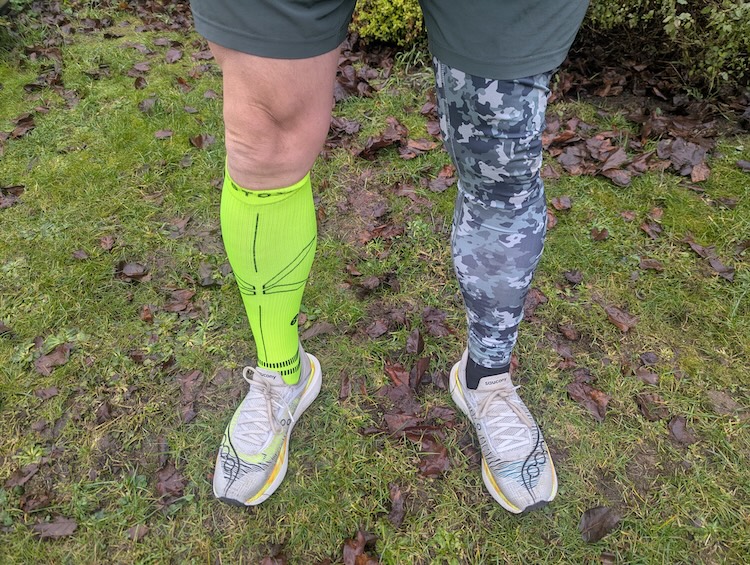
For this test I used the Stox Energy Socks and Champion Compression Leggings. As with all tests with any semblance of scientific backing I kept all other variables the same. I ran the same 10km route on alternate days for a fortnight, using the same shoes – the fantastic carbon Saucony Endorphin Elite 2 I do most of my tempo running in. I also kept my pace the same for every run – sticking to 5min 30sec/km. After each run I would keen the socks or tights on for an hour after, to allow them to promote blood flow and muscle recovery. The socks test was in December; the tights test in January – with temperatures fluctuating by no more than 5 degrees.
One small caveat to this test: for four or five years I have run religiously in compression socks because, as a 52-year-old runner with persistent shin splits, I have found their support invaluable. However I’ve only just started running in compression tights, usually using standard running tights in cooler weather. So running in compression tights obviously wouldn’t be so familiar to me – but I hoped I could still remain objective in my appraisal of both. I should certainly be able to measure comfort and recovery fairly objectively, even if the amount of support both offered might feel a bit more subjective.
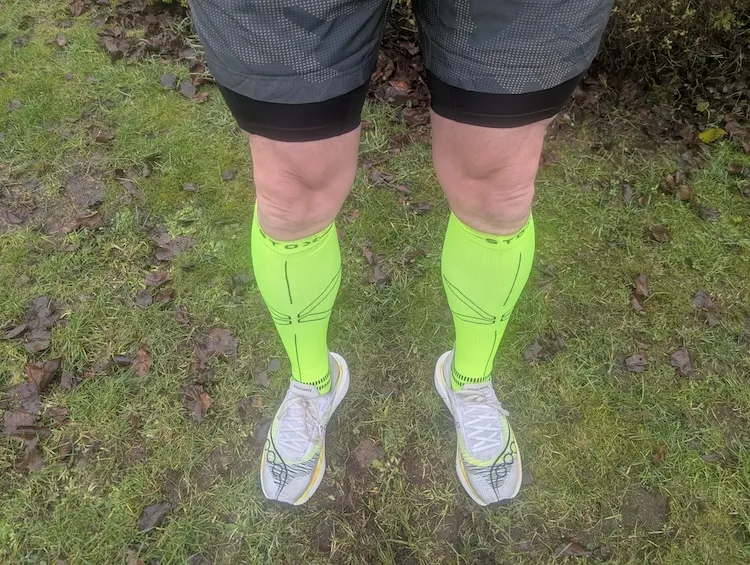
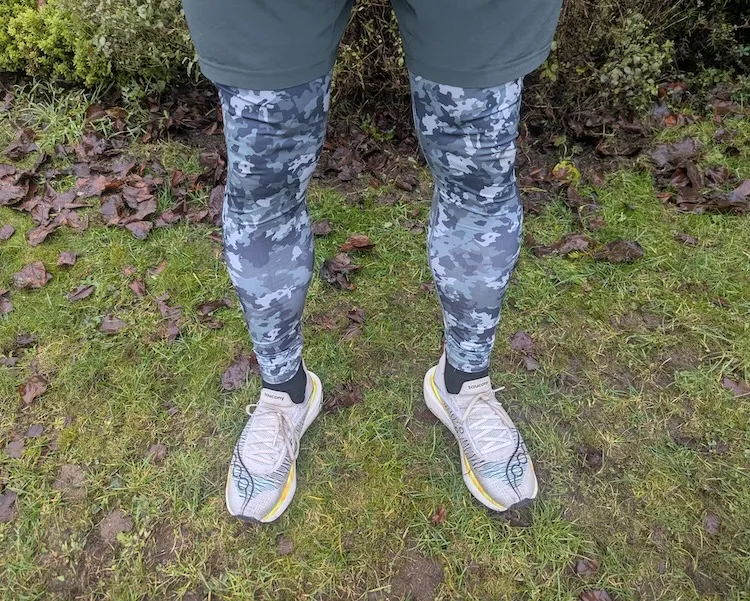
Compression socks vs compression tights in use
On my first run in the Stox Energy Socks, I could immediately appreciate the support they gave my calfs and shins. They weren’t quite up there with Falke Compression Socks I usually use (in terms of them feeling like they’d strapped my shins together!). They’re a little thinner, perhaps but still felt firm and secure below the knee and supporting my calfs. Foot comfort was good, they stayed in place throughout and kept the throbbing pain I get without good compression socks at bay. So far so good.
On my first run in the Champion Compression Leggings, I was immediately impressed with their overall comfort. Having not worn compression leggings before I was concerned about discomfort and chafing, particularly at the end of runs. But I experienced nothing of the sort – at least not yet. However I did start to feel a dull ache in my shins in the last 2.5km of the run. I was wearing UYN Run Winter One Socks underneath, which offered no shin support. The leggings weren’t quite doing enough on their own to keep shin splint pain away.
Recovery-wise, I felt no ill-effects using either socks or tights. But it was early days. I’d had two weeks off running before each test, so I was not carrying any real training load into either.
Half-way through the testing and some differences were starting to show. My shins were uncomfortable for longer after each run in the tights; my quads and thighs felt a little more fatigued in the socks. But comfort levels for both were good. I wasn’t experiencing any foot discomfort in the Stox compared to the dedicated UYN running socks. Likewise the Champion leggings were just as comfortable as the Runderwear Running Boxers I was wearing for every test – those perhaps lacking in a little ball-park support!
Compression socks vs compression tights – my conclusion
At the end of my test the results were pretty conclusive. My shins would start aching early on during runs in the tights, though overall support in the calf, thigh and quad areas was pretty decent. However I certainly felt I got some post-run recovery benefits, as keeping them on an hour after every run soon banished the shin aches (compared to running with no shin support). Upper leg fatigue was minimised, an area that troubled me after 70km in the socks. They, however, minimised all shin pain to just a faint niggle at the end of the last couple of runs. An hour afterwards, even that had disappeared.
Benefits of compression tights
If you’re not troubled by shin splints or are a younger or less regular runner, I would certainly recommend compression tights. The Champion ones I used weren’t even medical grade, and I still felt the benefits, particularly at the end of a long training block. I would probably go for a pair that incorporated dedicated crotch support, though, as I wouldn’t want to wear running underwear, tights and running shorts for fear of chafing. Something like these Skins Leggings would be ideal.
Benefits of compression socks
If, like me, you do suffer from shin splints, then there’s no substitute for compression socks. The feeling of solidity and stability is very reassuring and good compression really will nullify the kinds of vibrations that can ruin a shin splint-sufferer’s run. The sock part of most compression socks is usually as comfortable as dedicated running socks. However, if you swear by a particular brand of running sock you can always team them with compression cuffs (ie without the foot part).
Or, you can do what I’ve started to do. Deeper into my training load I tend to double-up now. Given the benefits I’ve noticed of compression socks to my lower legs and compression tights to my upper legs, I wear socks and tights through the colder months, benefitting from the targeted compression of both. For mature runners particularly, I highly recommend it!