
If you want to age well, you don’t have to train harder- you just need to train smarter. Try these 5 essential strength tests to age well
Stiff hips, creaking knees and everyday movements starting to feel harder? Most men don’t notice they’re losing strength until something simple becomes a challenge, like getting up from the floor, carrying heavy shopping or running up a flight of stairs. By then, muscle loss and power decline are already underway.
The good news? Much of this decline can be slowed – or even avoided – by prioritising functional strength before it starts to affect everyday life. And this can be measured using 5 essential strength tests.
“This is where functional training becomes non-negotiable,” says celebrity strength coach and Just Train CIC founder Michael Baah.
“I’m turning 40 this year myself, and I’ve felt that shift first-hand,” he says. “My focus has now moved away from just looking strong to actually moving well, to staying pain-free and performing consistently without breakdown.”
From a physiological perspective, three key changes are happening.
Why we slow down as we age
The first is sarcopenia, the age-related loss of muscle mass and strength that typically begins in your 30s. According to US researchers, muscle mass decreases approximately 3–8 per cent per decade after the age of 30, and this rate of decline accelerates after 40.
Alongside this comes power loss – the ability to produce force quickly drops faster than strength itself. Research in the Journal of Applied Physiology suggests that muscle power can decline by 2–4 per cent per year, which affects how quickly you react, stabilise yourself, and generate explosive movement.
Finally, there’s joint integrity, where coordination and stability become less reliable if they aren’t trained deliberately. This increases the risk of injury and making everyday movement feel harder than it should.
“If your training doesn’t help you move better outside the gym,” says Baah, “it’s missing the point.”
Here are the five essential strength tests Baah believes every man over 40 should be working towards.
1. Sitting–rising test
Why it matters: lower-body strength and longevity
Target: 10–15 controlled reps in 30 seconds
Can you sit down and stand back up from a chair without using your hands? Better still, can you sit on the floor and then return to standing?
Research published in the European Journal of Preventive Cardiology found the ability to perform a sitting–rising test with minimal support is strongly associated with long-term survival and independence. In short, the less assistance you need to stand up from the floor, the better your overall musculoskeletal health and longevity.
That’s because the movement demands strength, balance and coordination, as well as mobility through the hips, knees and ankles. It also strengthens the quadriceps, including the vital stabilising muscles around the knee which will not only improve your joints’ ability to tolerate everyday loading but also helps to prevent injuries.
2. Press-ups
Why they matter: upper-body strength and heart health
Target: 11–40 reps
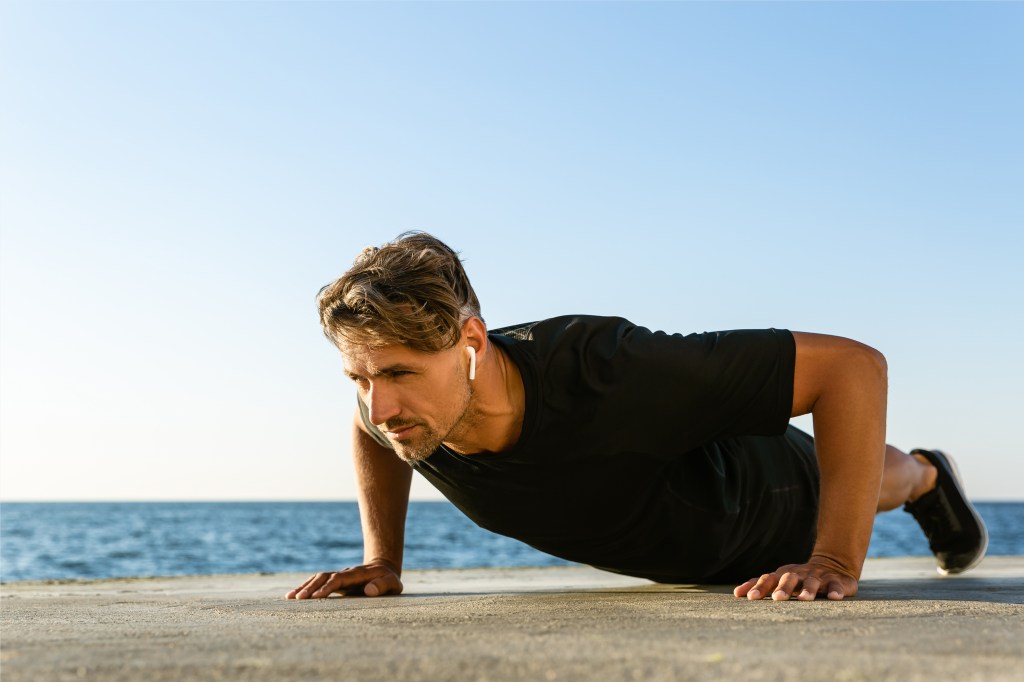
Press-ups remain one of the simplest and most reliable indicators of upper-body strength after 40. They test pushing strength, core stability, shoulder control and muscular endurance all at once, while reflecting the functional strength needed for situations like getting up from the floor or bracing yourself during a fall.
There’s also a strong link between press-up performance and cardiovascular health. Research published in JAMA Network Open found that men who could complete more than 11 press ups had a significantly lower risk of cardiovascular disease than those who could not.
3. Dead hang
Why it matters: grip strength and shoulder health
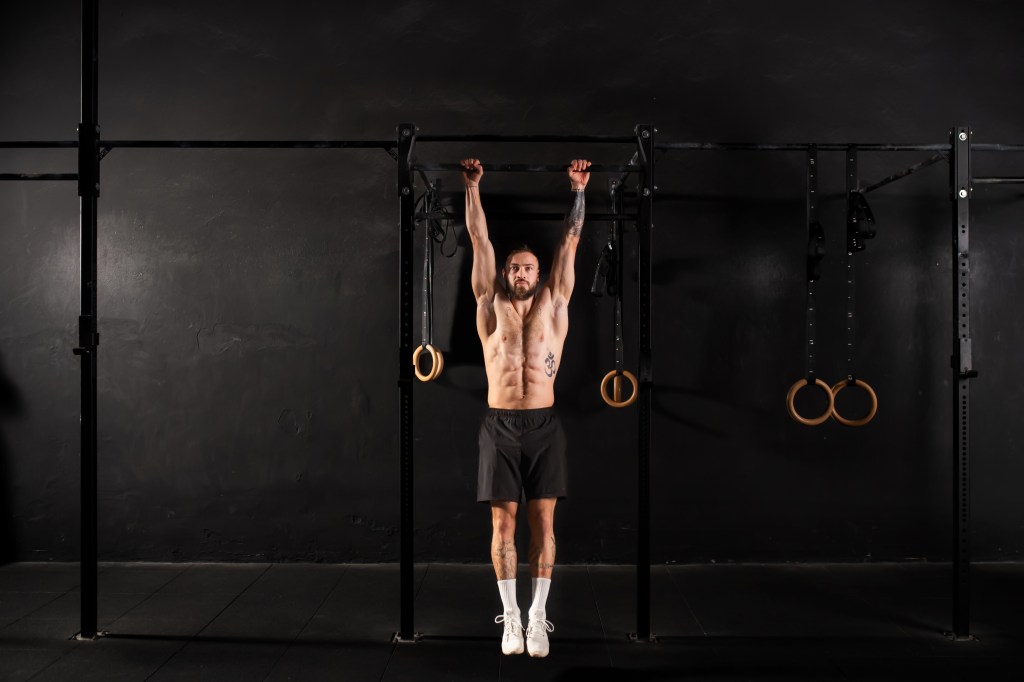
Target: 30–60 seconds hanging from a bar
To hang from a bar and support your bodyweight, you need grip strength – one of the clearest biomarkers of ageing and long-term health, according to large-scale studies published in The Lancet .
These studies linked stronger grip strength with lower rates of cardiovascular disease, diabetes and cognitive impairment.
That’s because grip strength is often a by-product of living an active lifestyle. If you deadlift, kettlebell swing or do farmer’s walks, you’ll naturally build grip strength through pulling and carrying movements. Even rowing on a machine improves grip strength, because you’re repeatedly pulling against resistance.
Grip strength also reflects forearm muscle mass, nervous system efficiency and the body’s ability to generate and control force. It often mirrors overall muscle quality and total-body strength capacity
4. Hip hinge
Why it matters: posterior-chain strength and back protection
Target: 8–12 controlled reps of a Romanian deadlift or kettlebell hinge with a challenging weigh
The hips are surrounded by powerful muscles, the largest of which is the gluteus maximus, the main muscle in the glutes. Along with the gluteus medius and gluteus minimus, these muscles help move the legs backwards and out to the side, while stabilising the pelvis. Keeping the glutes strong also supports the back, hips and knees.
5. Split Squat Hold
Why it matters: single-leg stability and balance
Target: 30 seconds per side in a deep, stable split-squat position
Most real-life movement happens one leg at a time, and the split squat builds single-sided strength that improves balance and stability while helping expose imbalances early and reducing injury risks.
Single-leg exercises also challenge the smaller stabilising muscles in the foot, glutes and core, while strengthening the quads, which, like squats and deadlifts, help to support the knees and improve joint stability during everyday movements.
How to use these benchmarks
If you can hit these numbers, you’re in a strong position. If not, it’s time to step up and set some new training goals.
“Prioritise control first,” says Baah. “Build the deadhang and the hold. Then add power by standing up faster on the sit to rise, moving with intent before introducing some light explosive work.”
Training two to three times per week is enough to maintain strength and resilience after 40.
“Most men over 40 don’t need more exercises,” he says. “They need the right ones. If you can sit, stand, push, hinge, hang and stabilise your body well, you’re covering the movement patterns that keep you strong, mobile and injury-free long term.”
“I’m applying these same standards to myself as I head into my 40th year,” Baah adds. “I still train hard, but I recover smarter and focus more on how my body performs than what’s on the bar.”
* Disclaimer; “Always consult your GP before starting a new exercise programme, especially if you have pre-existing health conditions, says Baah.”