
When a herniated disc ended defending champion Aidan Heslop’s 2025 season before it started, the youngest title-winner in Red Bull Cliff Diving history faced a far harder challenge than any 27-metre platform: learning to rebuild everything from scratch
PICS: Red Bull Content Pool
Having featured Aidan Heslop on the eve of his 2024 Red Bull Cliff Diving World Series title triumph, Men’s Fitness expected the fearless Englishman to spend 2025 defending his crown from the top of the 27-metre platform.
Instead, the youngest champion in the history of the sport found himself facing a far tougher challenge: recovering from back surgery after a herniated disc left his career hanging in the balance.
For more than a year, Heslop genuinely questioned whether he would ever high dive again. The physical pain was relentless, but the psychological battle proved just as brutal for an athlete whose identity had always been tied to pushing limits.
Now, on the eve of the 2026 World Series opener in Bali, Heslop is finally back. His remarkable comeback, documented in the Red Bull TV film 444 Days, is about far more than sport – it’s a story of resilience, reinvention and learning how to rebuild both body and mind when everything you love is suddenly stripped away.
“You always think it happens to someone else”
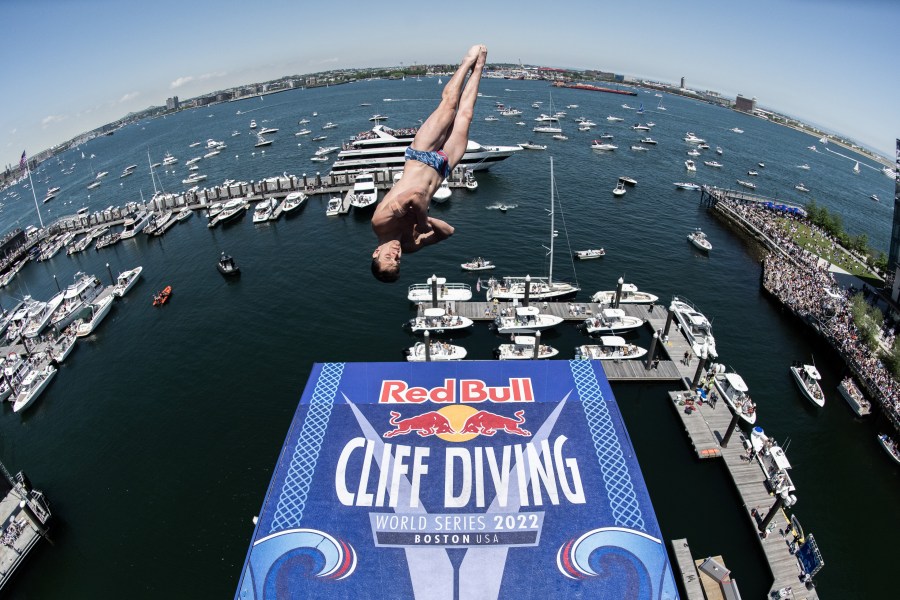
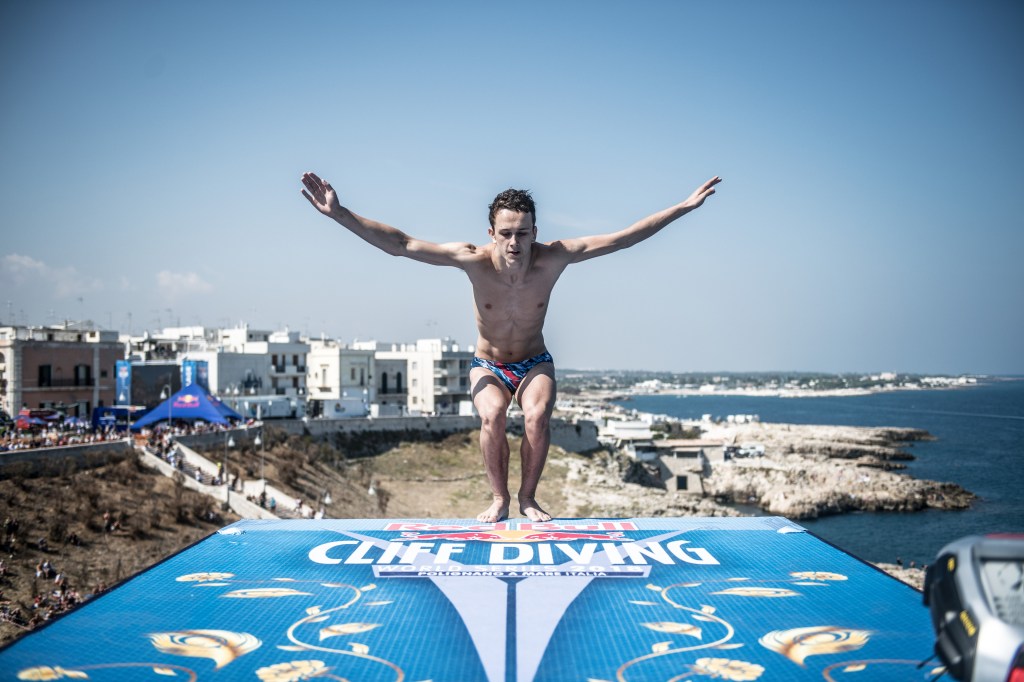
There’s a particular kind of silence that exists 27 metres above the water. It’s not calm. It’s not peace. It’s anticipation and instinct colliding in a fraction of a second before gravity takes over. Since childhood Aidan Heslop approached cliff diving with the kind of fearlessness that defines champions in extreme sport. “I never called myself invincible, others did,” he says. “But you always think it happens to someone else. It never happens to you. That was my mentality.”
Until suddenly, it did. Well, perhaps not suddenly. Heslop reveals that the pain had been building for months during the 2024 season. What initially felt manageable gradually evolved into something far more sinister, with nerve pain shooting down his leg after repeated high-impact dives from 27 metres. By the final stop of the season in Sydney, the damage had become impossible to ignore.
“Just a couple of hours after getting off the plane in Sydney, I bent down to pick up a chess piece in the park and it felt like I got stabbed in the back,” Heslop recalls. “I couldn’t even walk.”
For someone whose sport demands sprinting to the edge of a platform before launching into multiple flips and twists at speeds approaching 60mph, the reality was terrifying. “At that moment, I was convinced it was over. One hundred per cent. I thought: if I can’t even walk, how am I going to run to the end of a 27-metre platform and do the hardest dive in the world?” Remarkably, he still went on to secure the world title. But the celebrations were overshadowed by a growing understanding that his body could no longer continue in its current state.
Living with pain
Cliff diving is among the most physically brutal sports on the planet. Despite the elegance seen from the outside, every water entry delivers enormous force through the body, particularly when athletes are hitting the water vertically from extreme heights.
For Heslop, each impact became another layer of damage. “We were trying everything without surgery,” he says. “Physio, injections, rehab – it was the same process over and over again. I felt like I was banging my head against a brick wall.”
Eventually scans revealed the full extent of the problem: degeneration in the disc and a bulge pressing into the spinal canal. Surgery became unavoidable. Even then, the decision wasn’t straightforward. “When the surgeon sat me down and explained all the risks, that scared me,” Heslop admits. “He talked for about 20 minutes about what could happen and what that would mean for my life if something went wrong.”
For perhaps the first time in his career, genuine fear crept in. “I wasn’t really scared up to that point,” he says. “I was anxious, but that conversation was when the fear actually hit.” The operation in Munich on May 20 marked the beginning of a recovery process that would become as mentally demanding as it was physical.
Highs and lows of diving
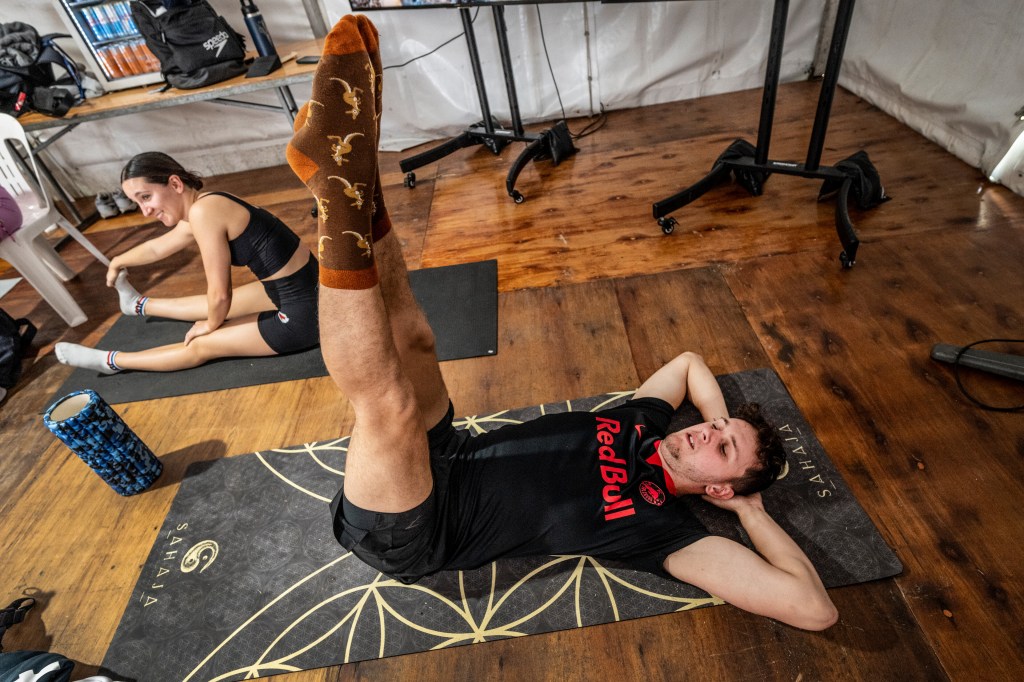
Elite athletes often speak about injury feeling like grief. For Heslop, the hardest part wasn’t necessarily the pain itself – it was the sudden loss of purpose. “I think I’ve done cliff diving all these years purely because I love it,” he says. “There’s nothing else in this world that makes me feel the same way.”
When that disappears overnight, the psychological impact can be enormous. His girlfriend, fellow cliff diver Molly Carlson, witnessed that struggle first-hand. “2025 was really hard to watch Aidan go through,” she says in the documentary. “It was the first time his joy was taken away.” Athletes in extreme sports often build their identity around movement, adrenaline and constant progression. Recovery demands the opposite: patience, stillness and restraint.
“He’s not someone who sits still,” Carlson says. “If he couldn’t dive, he’d find something else to move. So being forced to stop was really tough for him.”
Heslop admits there were moments where the uncertainty became overwhelming, particularly when he was still weighing up whether he could somehow compete despite the injury. “The hardest part mentally was January and February when we were trying to decide if I could make it back,” he says. “It was attacking me mentally every day.” Oddly, withdrawing from competition eventually brought relief. “When I finally said no, this massive weight came off my shoulders.”
Rebuilding from zero
The comeback started with tiny victories. Three and a half months after surgery, Heslop returned to a swimming pool simply to move again. Then came physio sessions, gym work and carefully controlled impact training. At four-and-a-half months post-surgery, he attempted his first 10-metre dive.
“I was nervous,” he says. “But excited.” For an athlete used to operating at the very edge of possibility, the process demanded humility. Every stage had to be earned back slowly. There’s a misconception that elite athletes recover faster because they’re mentally tougher. In reality, their greatest challenge is often learning not to rush.
For Heslop, that meant redefining success. “This whole chapter of my life has been a reset,” he says. “Ideally, I’ve still got years in this sport. This year became about learning how to be healthy as a cliff diver.”
That shift in mindset may ultimately prove more important than the physical recovery itself. At his peak, Heslop built his reputation on fearlessness and explosive talent. Injury forced him to evolve into something more sustainable: an athlete capable of longevity. “This is the year I grew up,” he says. “I wasn’t the reckless kid anymore. I wasn’t just someone who could do a bunch of flips. This was about becoming a real cliff diver.”
Back on board
The true test arrived in early 2026 during a training camp in Fort Lauderdale. Exactly 444 days after his last full-height dive, Heslop climbed the 27-metre platform once again. Physically, he was ready. Mentally, nobody can ever fully prepare for stepping back into a sport where hesitation can be catastrophic. Extreme sports require a unique relationship with fear. The best athletes don’t eliminate it; they learn to function alongside it. Heslop’s philosophy remains simple. “If you’re scared, then do it scared. That’s kind of how I live.”
His first dive back wasn’t perfect. He admits he got “wrecked a little bit” on entry. But something far more important happened: his body held up. “My back was solid,” he says. “Like it never even happened.” Suddenly, the possibility of a comeback became real again.
Molly Carlson remembers the emotion of that moment vividly. “I just hoped he’d do one good one and enjoy the moment,” she says. “He’d be the happiest boy.” When Heslop returns to competition in Bali this month he won’t simply be the defending champion making a comeback.
He’ll be a different athlete entirely. The time away has changed his relationship with risk, preparation and recovery. In a sport where pushing limits is unavoidable, he now understands the importance of protecting longevity. That maturity could make him even more dangerous competitively.
Before the injury, Heslop often relied on raw talent and fearlessness. Now there’s greater perspective behind the aggression. “2026 is about coming back smarter,” he says. “I still love the sport exactly the same way, but I understand now that you have to take care of yourself if you want to keep doing it.” That lesson resonates far beyond cliff diving.
Whether you’re an elite athlete or someone rebuilding after injury in everyday life, recovery often becomes less about returning to who you were before and more about becoming someone stronger, wiser and more resilient. Heslop’s comeback isn’t miraculous because he’s diving again. It’s remarkable because he learned how to stop defining himself solely through performance.
For 444 days, he was forced to confront the possibility that the sport he loved most might be gone forever. Now, standing once more on the edge of that 27-metre platform, the silence sounds different. Not empty. Earned.
• Red Bull Cliff Diving World Series
The title race begins in Bali (May 20–23), marking the Red Bull Cliff Diving World Series’ first-ever visit to Indonesia. The opening event is split across two locations that couldn’t look more different. In a genuine first in World Series history, at Kroya Waterfall divers will launch from a platform built directly in a tree, landing in a natural pool below. The final rounds then move to Kelingking Beach, where sheer rock faces meet deep turquoise water and white sand. This idyllic venue is definitely one of the most visually dramatic backdrops on the entire tour.