


The answer has nothing to do with how hard you work — and everything to do with the system around it. MyFitCoach allows individuals to train with a plan that finally makes every session count.
In partnership with MyFitCoach
I’ve been training for ten years and still hit a wall I couldn’t explain. Not because I stopped showing up — but because I had no idea the structure around my training had quietly broken down.
Ten years of training teaches you a lot. I know the difference between hypertrophy and strength work. I know why progressive overload matters more than any individual session.
I’ve read enough studies, tried enough programs and made enough mistakes to have a clear picture of what works — at least in theory. I’m also a dad with a full-time job and four hours a week I can realistically put towards training. Not four hours I can afford to waste. Four hours that have to count.
For a long time, I thought that combination — solid knowledge, consistent effort, limited time — was enough. And for a while, it was. I made progress. I felt strong. The sessions were productive. Then, slowly, without me noticing, they stopped being productive.
I was still showing up. Still working hard. But the gains had plateaued, the sessions had become routine in the worst sense of the word, and somewhere along the line I had drifted from training with a plan to training out of habit. Same exercises. Same weights. Same vague sense that something wasn’t quite adding up.
The honest question I eventually had to ask myself: if I know this much about training, and I’m still not progressing — what exactly is missing? The effort was never the problem. The structure around it was.
Why knowledge alone isn’t enough
Here’s something most experienced lifters won’t admit: knowing what progressive overload is and consistently applying it are two completely different things.
When you’re managing your own programming, it’s easy to add weight inconsistently, stay at the same load for weeks without noticing, or make adjustments based on how you feel rather than how you’re actually performing. The longer you’ve been training, the easier it is to confuse familiarity with optimisation.
The result is a plateau that feels invisible. You’re not regressing. You’re not skipping sessions. You’re just not progressing — and because nothing dramatic has changed, it takes months to realise the plan has quietly broken down.
For someone starting out, the problem is equally real — but for a different reason. Without the experience to build their own programming, beginners are left guessing. And guessing, however motivated, rarely produces consistent results.
In both cases, the solution is the same: a plan that’s built around you, adapts to your performance and removes the decisions that shouldn’t require your attention in the first place. That realisation led me to MyFitCoach — now used by over 100,000 men to train with a plan that finally makes every session count.

What changes when your plan is actually built around you
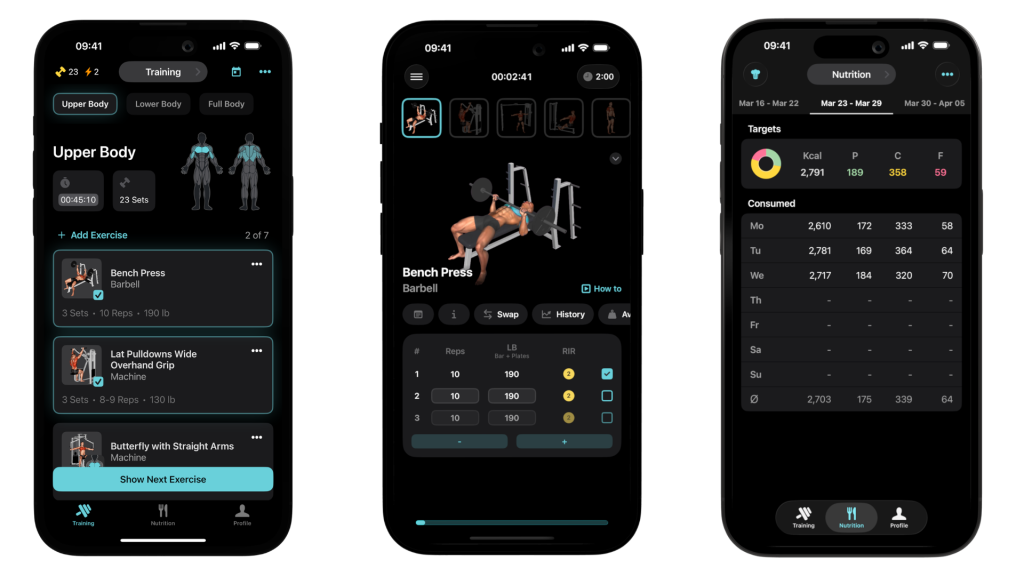
The first thing MyFitCoach does is ask the right questions — your training level, available equipment, how many sessions you can realistically commit to each week and how much time each session can take. The realistic version. Not the aspirational one.
From that, the app generates a fully personalized training plan grounded in current sports science. Not a template. Not a standard program with your name attached to it. A plan that reflects your actual situation — your schedule, your starting point, your specific objective.
MyFitCoach is AI-driven — meaning it learns from your performance every single time you train. It reads what you lifted, how you performed against the target, and adjusts your next session accordingly. Progressive overload happens automatically, in the background, without you having to calculate it, track it manually or make a judgment call mid-session.
This works regardless of where you’re starting from. Beginners get a clear foundation from day one — no guesswork, just a structured path built around you. Experienced lifters who’ve hit a plateau get a system intelligent enough to identify exactly what’s stalled and push past it.
Your role is straightforward: log your sets, check off your exercises, and if you already track nutrition or body weight in another app, MyFitCoach connects directly and pulls everything in automatically. It handles the decisions. You handle the work. And once that shift happens — the wasted minutes disappear.
➡️ Get your personalised plan here at MyFitCoach
Four hours a week. Zero minutes wasted.
Here’s the real cost of training without a clear plan: it’s not just the missed gains. It’s the time. Fifteen minutes deciding what to train. Five minutes trying to remember what you lifted last week. Another ten second-guessing whether to push harder or pull back. In a four-hour training week, that’s a significant percentage of your total time spent on decisions that a proper plan would have already made for you.
With MyFitCoach, you walk in knowing exactly what you’re doing. Every exercise, every set, every rep is already determined. A session that used to involve fifteen minutes of deliberation becomes fifteen minutes of additional training. Across a year, that compounds into something meaningful.
After a few weeks, something shifted that I hadn’t anticipated. The sessions had a logic to them that extended beyond that single hour — each one building directly on the last. I stopped finishing workouts wondering if they’d counted. I already knew they had. But the training is only part of it.
Beyond the training itself
Results don’t come from training alone — and MyFitCoach doesn’t pretend otherwise. Nutrition, recovery and how your body is responding week to week all determine whether your training actually produces what you’re working towards. You get personalised calorie and macro targets, updated weekly as your body changes.
A recipe library with 99 meals. A body weight tracker that feeds directly back into both your training and your nutrition so everything evolves together. And a recovery feature where you rate how each muscle group feels — so on the weeks your body needs less, your plan already accounts for it.
It’s not a logger. It’s a complete picture. One that gets more accurate the longer you use it. All of it feeding back into one thing: a plan that finally earns the effort you put in.

What ten years finally taught me
The effort was never the problem. The structure around it was.
Over 100,000 men have already stopped managing their own programming and started trusting a plan that does it better — beginners who needed a clear foundation, experienced lifters who hit a plateau they couldn’t break alone, and physique athletes who realised the mental load of self-programming was costing them as much as the training was giving them.
Different levels, different goals, one common realisation. I spent a long time believing that knowledge and consistency were enough. They’re not. Not without a plan that adapts, progresses and handles the variables you can’t manage yourself between the demands of a full life.
The moment you finally get the structure right — everything changes.
➡️ Get your personalised plan here at MyFitCoach