

Runners put a lot of stock in the the right pair of running shoes. That’s because their feet will hit the ground thousands of times during each run effort, and minimising that impact and the discomfort they can cause is the key to running efficiency – and being able to go again the next day. But what about moisture-wicking underwear? Given the amount your hips and upper legs move during those multitudes of running cycles – not to mention the heat and friction generated – surely this is an equally important choice too?
Running apparel companies have obviously given this a lot of thought. That’s why dedicated brands like Runderwear have sprung up in recent years. Not to mention the dozens of companies such as Crossfly and Step One, whose chief focus is designing underwear to withstand the rigours of working out – and to keep you comfortable while doing so.
Why you can trust Men’s Fitness
We spend hours testing every product or service we review, so you can be sure you’re buying the best. Our team of reviewers includes experienced product testers, PTs and fitness writers – as well as the core MF team – who know exactly what sets the best products apart from the rest. On this occasion, long-term contributor and expert kit reviewer Laurence McJannet conducted this test to see which was better for running: moisture-wicking underwear or 2-in-1 shorts. Find out more about how we test.
However, there is another option when looking at staying friction-free and comfy while running. That’s choosing a pair of lined or 2-in-1 shorts – thereby negating the need for moisture-wicking underwear completely. I’ve been running for the past month and a half using both options – on both tempo 5km road efforts and longer 15-20km trail runs – to see which is best.
For the lined shorts I went for the versatile Vuori HardKore Lined 5in Short, which has a light mesh boxer-style liner. For the run shorts and moisture-wicking underwear I went for the Montane Volantis 7in Shorts (deemed our best lightweight adventure run shorts) and the Step One Boxer Brief Sport (which we voted best for chafe-free comfort).

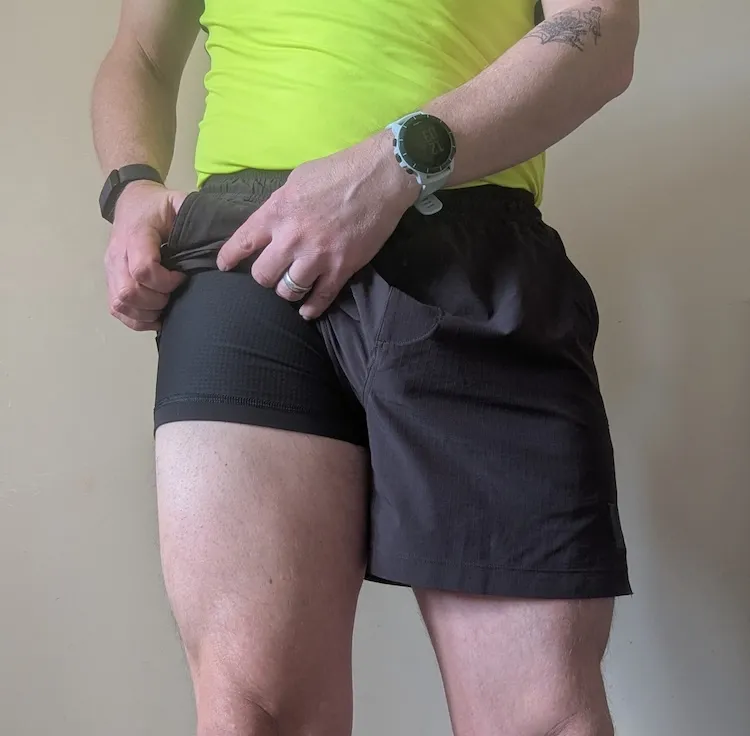
How I compared moisture-wicking underwear vs 2-in-1 shorts
Over six weeks in late winter/early spring I set up a controlled series of runs to try to make sure any comfort or chafing issues were not influenced by previous efforts. I went for a run every three days, which I hoped would allow any soreness from the previous run time to dissipate. I alternated between 5km tempo road runs in lined shorts then in moisture-wicking underwear, and 15-20km trail runs in the same apparel. Every other piece of gear – Saucony Endorphin Elite 2 shoes for road; Inov-8 TrailFly G270 V2 for the trails, Stox Energy Socks – remained the same throughout.
Moisture-wicking underwear vs 2-in-1 shorts – testing
In total I put in 16 runs to try and formulate a worthwhile comparison. That was 4 x 5km efforts in both lined and regular shorts, and 4 x 18km (average) in both as well. That added up to 184km over six weeks, running every third day – a decent amount to make an informed (if not scientific) decision.
With that amount in my legs I was a little surprised at the end that at no point did I suffer any chafing around my waist, groin or where any seams touched my skin. That’s testament to the design of both the Vuori HardKore and Montaine Volantis shorts and Step One boxers. Seams on each of them are minimal, and the waistbands wide and soft, none of which would roll up or cut in.
However, comfort was a noticeable difference, and I reckon would become more so during warmer weather. As I mentioned in my original review of the HardKore, the mesh liner has a barely-there feel which means over short and long runs alike it helps you forget they’re there. The Step One boxers, however, have more material and weight to them, and although they’re comfy, they’re also noticeable. That doesn’t sound like much, but if you’re hours deep into a long endurance effort, noticeable can become distracting.
Plus the Step Ones are as long as the 7in Volantis, so that extra length (compared to the 5in HardKore) and weight is doubled across that entire length. And although there are no annoying seams, that soft material is still closer to your groin, which means an unavoidable build-up of heat and moisture. At times during longer efforts, that too became noticeable – and distracting. And I could see in hotter weather how that could amplify over time to become uncomfortable.
Moisture-wicking underwear vs 2-in-1 shorts – results
The long and the short of it is, for short tempo runs I didn’t notice a difference in chafing risk between the running shorts, as there was none. And comfort was pretty equal too. If anything I thought the moisture-wicking underwear and shorts set-up is better because of the support I felt around my crotch and upper thighs.
On longer runs, particularly over uneven ground, however, I don’t think there’s much doubt that the 2-in-1 lined shorts were the better bet. I always felt the liner was lighter, comfier and less distracting, with plenty of air flow and no build-up of heat or moisture. When you’re wearing moisture-wicking underwear and regular shorts – no matter how good both are at moisture management – there is an unavoidable build-up of heat and moisture over time due to that double layer. Make that three layers if you tend to wear running tops that extend quite far below the waist band.
That’s why this test has been really useful for me. From now on, I’ll always be picking a pair of lined 2-in-1 shorts for anything over 10km – particularly off-road. Low weight, good air flow, no pinching or chafing risk – that’s a winning combination that I will be sticking to.