

From NADs to collagen powders, the longevity market is booming – but can any pill really slow ageing? We break down the science, the hype and what’s actually worth your money
If you’ve ever been worried about the effects of ageing – as Tom Jones would say – ‘it’s not unusual’. In fact, there’s now a booming longevity supplement market claiming to have the answers to exactly that problem.
“Who doesn’t want to buy an anti-ageing supplement?” says Sophie Bertrand, Resident Nutritionist at Abbott’s Lingo, mum of two and co-host and author of Forking Wellness book and podcast. “But it’s so difficult to have a one size fits all solution because everybody is so different.”
“I think so many people really hope for a magic fix when they take a supplement,” she says. But what are we even talking about when we say longevity supplements?
“There’s no kind of standard definition for an anti-ageing supplement,” says Sophie. “What all supplements are trying to do is aid something that should already be in the body which is declining or lacking,” she explains. “Supplements come in many different forms: so it could be like a powder or a pill, a gummy – there’s so many different ways in which you could take supplementation.”
“When you look at the ingredients of a longevity or anti-ageing supplement, what we tend to associate them with are things like collagen or protein, amino acids, vitamin C, omega 3 and sometimes vitamin D.”
What are NADs and can they help?
One of the big longevity supplements currently on the health market are NADs. Nicotinamide Adenine Dinucleotide (NADs) are coenzymes found naturally in every cell of our body.
“They’re essential for energy production, metabolism and DNA repair, so theoretically, taking NAD will then help with your energy production, metabolism, and cell turnover, as this does naturally decline with age,” says Sophie. “Again, theoretically, if you take the supplement, you can mitigate the effects that come with ageing.”
Like with many supplements, it’s important to note that NADs are not FDA approved. “Always be very careful about where you’re getting it from, supplements are very unregulated,” says Sophie.
“NADs are relatively new, so in five years’ time we might have the research to say that taking an NAD supplement really does mitigate the effects of ageing, but because there are so many different types of supplements out there, it’s really difficult to say, yes, this will help with the with the wrinkles that are appearing on your face.”
“There’s growing research for sure, but there’s nothing really solid to say, OK, let’s just supplement it and then we can reverse the ageing process. It’s not quite that simple,” she says.
So, what about collagen?
“Our bodies make collagen – it just declines as we get older,” explains Sophie. “You can take it in a powder or a pill or a gummy, and there is some evidence to say that they improve things like skin hydration, and elasticity.”
“It’s interesting because there’s actually more research to support collagen supplements in regards to joint health – with a lot of the skin health there’s a lot more anecdotal evidence than there is actual research or evidence-based studies.”
“Collagen is better absorbed with vitamin C, so if you’re going to take it, have it with a vitamin C rich food. Most collagen products do include vitamin C and zinc in the actual supplement because we know that’s when those vitamins work best together,” says Sophie, advising to check this on your products.
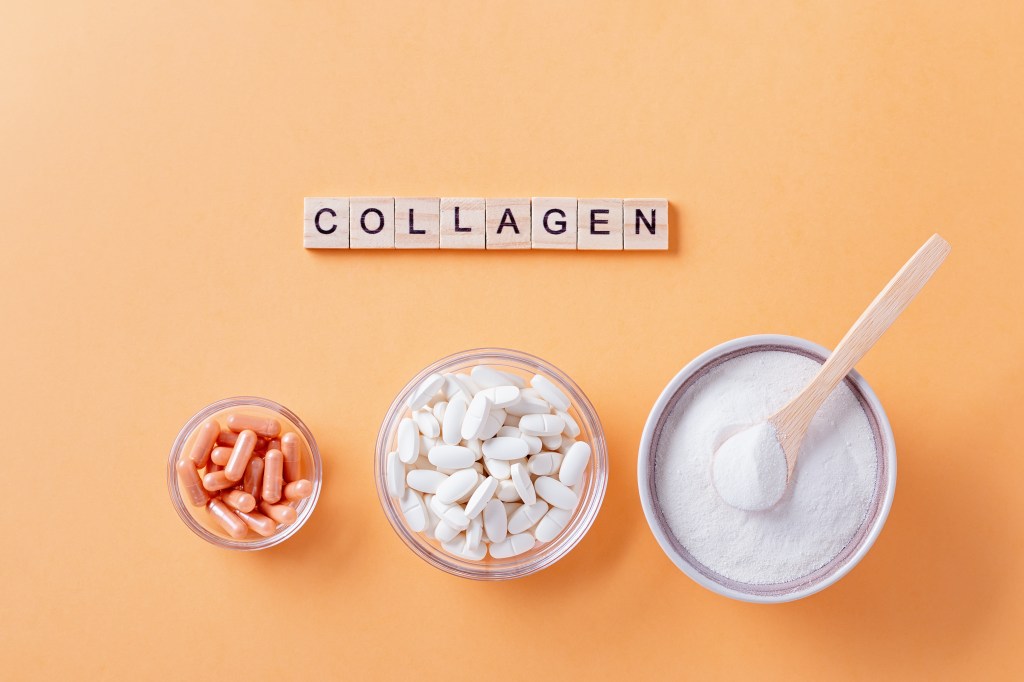
“I’ve got nothing against [collagen supplements],” says Sophie. “I sometimes put collagen in my matcha for an extra bit of protein!” It is important to note however, that collagen is not a complete amino acid, she explains: “I think some people think they’re getting like a double whammy, but so it doesn’t contain all the essential amino acids, so it’s good to be aware of what you’re taking.”
If you are going to take them, Sophie says that it’s important to be realistic about what you expect from the results. “They’re not magic – you’re not going to start looking five years younger if you take them!”
Worth the hype?
So, are anti-ageing supplements worth taking? “I would say within reason,” says Sophie. “It would completely depend on your lifestyle, what you were trying to improve and how your body responds to certain nutrients.”
Sophie also points out that you should make sure you’re already doing all the necessary things for a healthy balanced lifestyle before considering introducing anything extra.
“You need to be doing the core foundation – you can’t just rely on a supplement to make everything better. When you’ve got all those basics [sleep, exercise, healthy diet etc], then I would look into supplementation.”
“It’s also really important to point out how expensive they can be,” says Sophie. “Obviously it’s a big investment, so if you’re going to go down that route, you need to make sure that you’re getting the right stuff and doing it properly,” she advises. “The influencers in the adverts are getting paid, remember that.”
But that’s not all; there’s no guarantee that just because a supplement works, that it will work on you. “How the body uses a supplement and the bioavailability of it also has to be considered – and that’s something that is really difficult to prove,” explains Sophie.
“Take a standard probiotic: unless that company has the clinical trials, there’s nothing to say that that probiotic is going to actually reach your gut because your stomach acid is so strong it’s potentially destroyed before it even gets there.”
“I would always recommend researching the actual supplement that you’re taking, and the brand that you’re buying from and if you’re really stuck, consult with your GP or a nutrition professional.”