
Compound lifts, unilateral exercises and a relentless focus on technique helps football legend Lionel Messi stay strong, agile and match-ready well into his late thirties
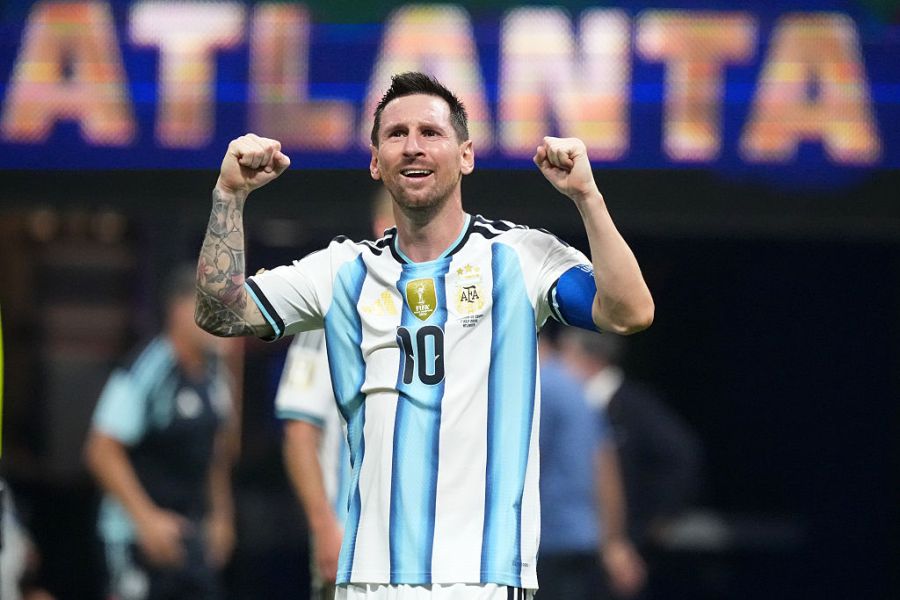
At 39 Lionel Messi is still playing in FIFA World Cup Finals, probably the greatest player of all time, and one of the few his age still competing at the top of his potential. His training during the World Cup has been leaked, and it shows that the secret to Messi’s success (being a footballing genius aside) is that he keeps the workouts functional. Here’s the breakdown of what Messi’s workout routines comprise.
Why Messi focuses on functional fitness
Messi needs to perform on the pitch, and he’s aware that when it comes to strength training as an athlete, the aim is to use the gym to improve your ability to keep fitness high on the pitch for longer. For Messi, this means doing strength training that acts as a fresh stimulus for the full kinetic chains of the body (i.e. strengthening natural movements, not targeting individual muscles).
In practice, this means a focus on compound exercises, and doing them unilaterally where possible to help reduce imbalances. In this workout, Messi runs through Pull-ups, single-arm rows, single-arm dumbbell curls (while holding the other arm in a fixed position to stimulate the core), russian twists that incorporate slams with a small medicine ball, crunches, and overhead sit-ups using a medicine ball to intensify core activity and build in some overload. Where possible, exercises activate full kinetic chains to replicate being strong in the ways the body actually moves on a pitch and in life. All these exercises use a medium-to-low weight, and there’s no sense of struggling on into failure territory.
Stability and form over ego and weight
Unless you’re trying to be a mass monster in your younger age, this is always true (and sensible). If you look at the way Messi works through these movements, it almost looks as though (aside from making sure to be explosive in cable rows for instance) Messi is barely trying. Movements are very precisely controlled, and he is completely focused on his form.
Good form isn’t just about injury prevention, either. Though that is important (imagine straining a muscle between World Cup matches when you are the most watched player in the world) good form helps to protect joints by not loading them in unnatural ways. Creating the right conditions for your body through correctly working muscles also helps it to stimulate collagen production and increase bone density.
Workout smarter, not harder. Especially as you age
Many of the exercises Messi does have multiple benefits for his game. Pull-ups, for instance, are a solid workout for any routine but alongside their ability to build muscle and bone mass across the entire back, shoulders, biceps, and core, they also seriously test grip strength.
Now grip strength might not be associated with outfield footballers beyond throw-ins, but actually between physical duels, jumping for headers, and explosive sprints, grip strength can provide the marginal gains needed to get ahead of the opposition.
Grip strength is also something that quickly deteriorates with age, and has been called an “indispensable biomarker for older adults” with a study showing the “predictive link between grip strength and all-cause and disease-specific mortality, future function, bone mineral density, fractures, cognition and depression, and problems associated with hospitalisation”. Compelling stuff, and all the more reason for Messi to find ways to incorporate it into his training.
Also, in terms of strength training, grip strength will help his form across other exercises – whether it’s medicine ball twists or simply putting less strain on his forearm when doing curls. One exercise, several results.
Core is king
A constant through these exercises is that they are done with a conscious effort to stimulate the core. This is ideal for balance, which is one of those on-pitch skills that has made Messi quite simply the greatest player of all time, but also is integral to making sure the body doesn’t overload on either side unnecessarily. This also ensures other muscles don’t compensate as he gets further into matches or tournaments, keeping him fit for purpose.
While Messi’s career has been long, and frankly, impeccable, he has missed almost three entire years due to injury. This must have informed his approach and dedication to a fitness regime that is above all, designed to help him stay fit, and perform at his best, above all else.
Don’t neglect mobility and recovery
Another hallmark of elite footballers like Messi is that strength training doesn’t exist in isolation. Mobility, flexibility and recovery are treated as equally important parts of the programme, helping the body cope with the demands of repeated training sessions and matches. Dynamic warm-ups, stretching and recovery work help maintain joint range of motion and muscle function, allowing athletes to move efficiently while reducing the likelihood of overuse injuries. For recreational athletes, spending just 10 to 15 minutes on mobility work before and after training can pay dividends over the long term.
Quality beats quantity
Messi’s workouts are also a reminder that more isn’t always better. Rather than spending hours in the gym or lifting to exhaustion, his sessions are purposeful and efficient, with every exercise chosen because it transfers directly to his performance on the pitch. Sports scientists have long emphasised that quality of movement is more important than the number of exercises completed, especially for athletes whose primary goal is performance rather than muscle size. If an exercise doesn’t improve speed, stability, power or resilience, it probably doesn’t deserve a place in the programme.
Train for the life you want to live
Perhaps the biggest lesson from Messi’s training is one that applies whether you’re playing in a World Cup final or simply trying to stay fit into your 40s, 50s and beyond. Functional strength training develops the movements you rely on every day – lifting, twisting, sprinting, changing direction and maintaining balance—while helping preserve muscle mass and coordination as you age. You may never dribble past five defenders like Messi, but training your body to move well rather than simply lift heavy is a strategy that can keep you stronger, healthier and more active for years to come.