

Erg training isn’t just for HYROX: Sarah Haselwood explains why you should include it in your weekly routine
If you’ve heard of HYROX (if you haven’t, where have you been?), watched it or been a participant, you’ll know that ergs form two out of the eight functional workout stations. The first workout station is the 1000m ski erg, with the 1000m row erg as the fifth station. But don’t be fazed by these pieces of workout equipment. It’s easy to incorporate them into a weekly workout in various ways to provide full-body aerobic workouts or a combination with strength training.
What is erg training?
In the fitness world, ‘erg’ is short for ‘ergometer’, a type of cardio machine that simulates the motion of specific activities. For example, the ski erg is designed to allow you to practise double-pole cross-country skiing. The ski, cycle (sometimes referred to as the assault bike) and row ergs each have a flywheel to use air resistance during activity.
James Davis, Coaching Psychologist, Author and PT says about ergs: “Even if you’re not training for a specific sport, these machines provide excellent overall exercise options that combine cardiovascular conditioning with muscular endurance and strength, and because they’re both low impact and challenging, they’re great to build into a workout.”
Erg equipment
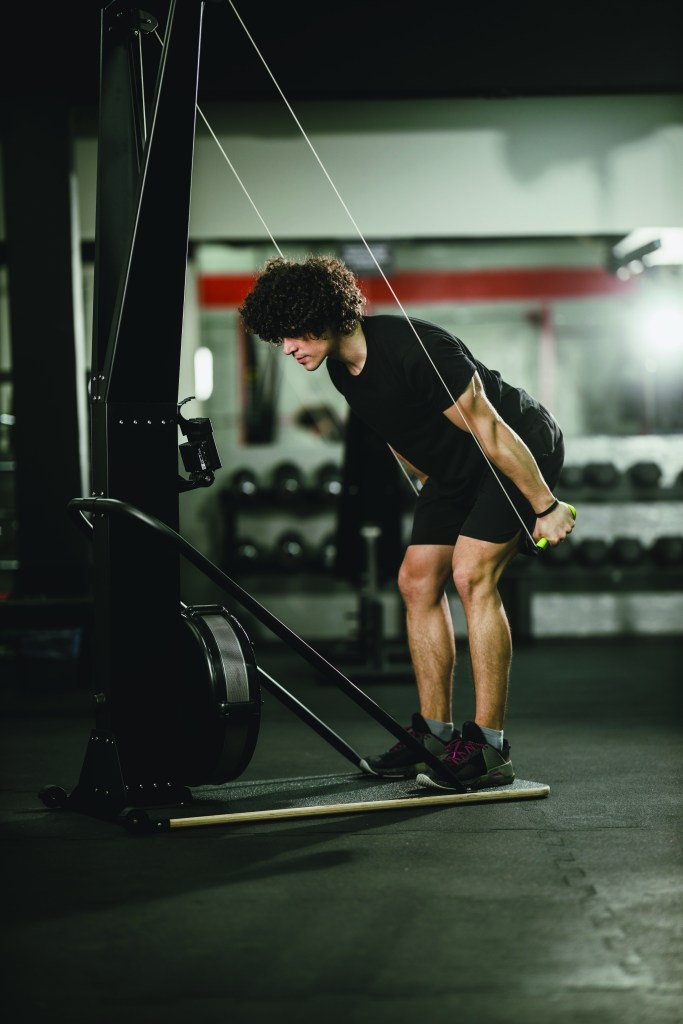
Ski ergs primarily focus on the muscles in your arms, shoulders, and core. However, when used properly, they also engage the muscles in your legs, making it a great full-body workout.
This rowing erg is perfect for a full-body workout and also allows low-impact training. It targets every major muscle group and works effectively for both beginners and advanced rowers, as well as for short speed bursts or endurance sessions.
Davis says: “If you’re specialising in something specific, then the erg for that particular sport can be a great way to train your sports-specific technique. For example, with the rowing erg, you’ll work the same muscles you use rowing and build endurance, strength, power and muscle memory in the same movement pattern you’d use in a boat.”
The bike erg provides a realistic cycling experience that builds strength and endurance. As you ride faster, you feel more resistance, just like on the road. It also features a unique design where the flywheel continues to spin even when you stop pedalling, making your workout more authentic.
Why bother?
Erg workouts are popular, and they bring numerous benefits:
Cardiovascular: Doing a cardio erg activity is beneficial for your heart and overall health. This kind of exercise gets your heart pumping, which boosts your endurance and cardiovascular health. Regular aerobic exercise can help lower your blood pressure, decrease the risk of heart disease, and enhance the heart’s overall function.
Low impact: One of the best things about erg workouts is that they are gentle on your joints. One study found that practising rowing three times a week over eight weeks improved joint rotations in the elbows, shoulders, and knees by 30%. Activities like running can sometimes cause joint pain, but ergs create smooth movements that are easier on your body. This makes ergs an excellent choice for injury recovery workouts or for those with joint problems.
Muscle development: Erg workouts are also fantastic for building strength and muscle. Research shows that cycling can help to maintain muscle mass, and the resistance from the ergs challenges major muscle groups.
Calorie burn: If you’re looking to burn calories, erg workouts can be very effective. Using the ergs to ski, row, or cycle is an intense exercise that burns a significant number of calories quickly because it engages multiple muscle groups simultaneously.
Adaptable: Davis says: “Longer steady-state erg efforts are excellent for building aerobic endurance, while short bursts or interval formats such as Tabata can deliver high-intensity conditioning and serve as an effective finisher after a weight session. Weights are glycogen-intensive, and a short HIIT burst on an erg can help squeeze that last metabolism boost from your workout.”
Erg performance
While you need to practise on the ergs to see how they feel, there are some basic technique tips to help you get the most out of them, reduce the risk of injury and improve performance.
- Ski technique
When you’ve never done skiing or the ski erg before, it can be daunting to know how to do it correctly, especially when you see others flying through the motions. F45 trainer Ben Scarles suggests reaching high, sending your backside back quickly, using your body weight to crunch through your stomach, and then sending the handles back to your pockets. He adds that at 90 degrees, don’t continue down, but bounce up to the next stroke, as you’ll make the meters at the top of the stroke, not at the bottom.
He adds: “The two key areas are the crunch through the torso and the driving down through the elbows. Things to avoid are getting stuck in short, stumpy strokes like Thomas the Tank Engine. We want to extend our arms, reaching up to elongate the stroke to increase the range of the movement.”

- Rowing technique
Scarles says that the strapping across the widest part of your feet is a misconception. Instead, he advises that the strap should go over the base of your toes, not too tight. During movement, the heels should come off, but the ball of your foot should be the primary contact point.
“A common mistake is tucking the bum under, slouching through the back, or driving through the legs but bouncing the knees back up after they extend and thus pulling you back to the front,” says Scarles. “Don’t overly extend at the back. Metres are made at the front of the stroke, not the back. It’s a deadlift movement. You wouldn’t round your back in a deadlift; don’t do it on the rower.”
Added versatility
Ergs create numerous options for workouts, providing access to versatile exercise routines that enhance fitness and reduce boredom. Here are some ways you can use them in your weekly training:
Speed workouts: A short sprint can help you to focus on technique, pacing and your breathwork. While erg sprinting may feel tough, power sprints will develop fast-twitch muscle responses and develop your explosive power.
For example, a 500m sprint on the ski erg will require you to start strong to get the flywheel spinning and then find your pace, form and stroke rate.
Timed sprints: You can perform a timed session with short sprints incorporated. For instance, you could include timed sprints on the ski/cycle/row erg by doing 30 seconds maximum effort with 60-90 seconds easy exercise in between each interval.
Scarles recommends combining speed with strength. He says: “If you’re doing a lower-body resistance session, you can add in some short sprints on the bike to pre- or post-fatigue the muscles, meaning you won’t have to go as heavy with the weights to achieve a similar level of metabolic stress to promote growth.”
Endurance workout: There are various ways to carry out endurance training and mixing it up can help reduce boredom. One way to do this is to train for a set period and measure your heart rate throughout (e.g., 30 minutes of continuous rowing at 60-70% of your maximum heart rate).
Pyramid workout: This will help with pacing, endurance and speed. To start, do a 5–10-minute easy warm-up on the erg of your choice, and then proceed to 250m, 500m, 750m, 1000m, 750m, 500m, and 250m. Between each distance, take a 2-3 minute rest by skiing, cycling, or rowing lightly. If possible, incorporate speed by going faster on the shorter distances.
Ergs plus strength
If you’re not keen on a full-on cardio workout, you can easily practice ergs alongside weights for optimal performance.
Regular EMOMS (every minute on the minute) can be adapted for the ergs. Try a 10-minute erg warm-up, and then every minute (or every two minutes if it’s more practical), perform 10 reps of a strength exercise, followed by the remainder of the minute with erg speed work.
Davis says if you repeat the workout below for 3–4 rounds with a short rest between rounds, “you’ll hit every major muscle group while keeping your heart rate elevated and your lungs working hard”.
- 250m row sprint
- 15 push-ups
- 250m ski erg
- 15 kettlebell swings
- 250m cycle erg
- 15 squats
Set targets
Whether you’re using ergs in a circuit with others or doing some solo training, you can measure your performance and progress. Davis agrees: “You can track your distance, watts, or calories, meaning you can compete with your friends, compare notes and track your progress easily.”
Scarles concludes: “You can mix and match, moving from one erg to another to keep a cardio session more interesting. You can also set targets on the screens. These small targets within a workout help to maintain a set level of effort throughout.’’