
Forget complicated programmes and punishing workouts. Trainers and longevity experts say a handful of movements can dramatically improve strength, balance, joint health and lifespan after 50
Images: Getty Images
There’s a moment many men experience somewhere after 50 when fitness starts to feel different.
The workouts that once felt effortless now leave joints aching for days. Recovery slows. Old injuries return. Energy becomes less predictable. And suddenly the goal is no longer simply looking fit — it’s staying capable.
That shift matters. Because fitness after 50 isn’t really about chasing the body you had at 25. It’s about preserving strength, mobility and independence for the decades ahead.
And according to many trainers and physiologists, the solution isn’t more exercise. It’s better exercise.
In fact, a relatively small number of movements can have an outsized effect on how well the body ages.
These aren’t flashy gym exercises or social media workout trends. They’re foundational movements that improve strength, posture, balance and resilience — the physical qualities most associated with healthy ageing.
Here are the five exercises every man over 50 should prioritise.
1. The Squat
If there’s one movement that defines functional fitness, it’s the squat.
Squats strengthen the glutes, quadriceps and core while improving mobility through the hips and ankles. More importantly, they train one of the most essential real-world abilities of all: getting up and down safely.
That becomes increasingly important with age. Many men stop squatting because of knee pain or stiffness, but avoiding the movement entirely often makes the problem worse. The key is adapting the exercise appropriately.
For some men, bodyweight squats are enough. Others may benefit from goblet squats holding a dumbbell, or box squats that reduce strain on the knees.
The goal isn’t maximum weight. It’s maintaining lower-body strength and movement quality.
Strong legs remain one of the clearest indicators of long-term physical health.
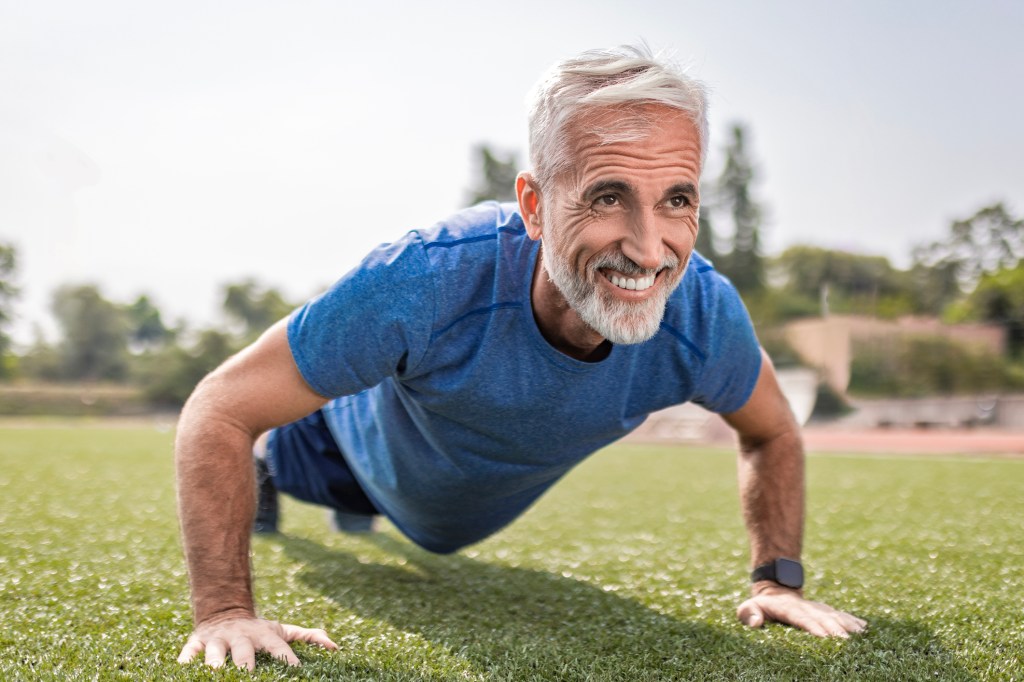
2. The Push-Up
The push-up remains one of the simplest and most effective upper-body exercises ever created.
It strengthens the chest, shoulders, triceps and core while reinforcing shoulder stability — something many men lose gradually with age.
Importantly, push-ups also train the body to move as a coordinated unit rather than isolating muscles individually.
That has real-world benefits far beyond aesthetics. And despite their reputation as a basic exercise, push-ups remain surprisingly challenging when performed correctly.
The good news is they’re easily adjustable. Incline push-ups using a bench or wall can reduce strain while still building strength and stability.
Consistency matters far more than complexity.
3. Loaded Carries
Few exercises mimic everyday life better than loaded carries.
Whether it’s carrying shopping bags, luggage or heavy boxes, the ability to move while carrying weight is one of the most practical forms of strength there is.
Loaded carries — such as farmer’s walks holding dumbbells or kettlebells — train grip strength, posture, core stability and cardiovascular fitness simultaneously.
They also expose weaknesses quickly. Poor posture, reduced balance and weak core muscles become obvious within seconds of carrying heavy weight across a room.
Grip strength alone has become an increasingly important marker in ageing research, with studies linking it to overall health and longevity. Loaded carries are simple, brutally effective and often overlooked.
4. The Row
Modern life tends to pull the body forward. Hours spent sitting, driving and looking at screens contribute to rounded shoulders, tight chests and weakened upper backs. Over time, posture deteriorates and shoulder problems become more common.
That’s why rowing movements matter so much after 50. Exercises such as dumbbell rows, seated cable rows or resistance band rows strengthen the muscles of the upper back and help counteract years of poor positioning.
Better posture doesn’t just affect appearance. It influences breathing, shoulder health and overall movement quality.
Many men focus heavily on pushing exercises while neglecting pulling strength altogether. Rows help restore balance.
And for men experiencing neck tightness or upper-back stiffness, they can be transformative.
5. Walking
It’s easy to overlook walking because it feels too simple to count as “real” exercise. But walking may be one of the most powerful health tools available after 50.
Regular walking supports cardiovascular health, joint mobility, recovery, mental wellbeing and weight management — all without heavily taxing the body. It’s also sustainable.
Unlike punishing workout plans that often collapse after a few weeks, walking is something most people can maintain consistently for years.
And consistency is what matters most. Many fitness experts now argue that daily movement is more important for long-term health than occasional extreme workouts.
Walking also complements strength training particularly well, helping maintain mobility and recovery between harder sessions. It may not feel impressive, but its impact accumulates over time.
Why These Exercises Matter More After 50
What makes these five movements so effective is that they train the qualities men gradually lose with age if they stop challenging the body:
- strength;
- balance;
- coordination;
- mobility;
- posture;
- and cardiovascular fitness.
That decline is not inevitable — but it does require intentional effort to resist.
The mistake many men make is focusing too heavily on aesthetics or intensity while neglecting function. Fitness after 50 works differently. The priority becomes building a body that remains useful, resilient and adaptable.
Can you move confidently? Carry weight comfortably? Recover well? Stay active without pain? Those markers become far more meaningful than chasing extreme fitness goals.
The Midlife Shift
There’s also a psychological change that happens in midlife fitness. Many men stop exercising because they feel they can no longer perform at the level they once did. But fitness after 50 isn’t about competing with your younger self. It’s about protecting future quality of life.
The men who stay strongest into later life are rarely doing the most complicated workouts. More often, they’re repeating simple fundamentals consistently over years. And that’s the real midlife fitness formula. Not punishment. Not endless cardio. Not training like you’re still 25.
Just smart, sustainable movement patterns that keep the body strong for the long haul. Because after 50, the goal is no longer simply adding years to life. It’s adding better life to those years.